


Shipping activity in the Black Sea continues to decline as attacks on merchant vessels and port infrastructure intensify. In October 2026, 1,370 cargo ships with a deadweight tonnage exceeding 1,000 tonnes operated in the region, a 37% decrease compared with the previous year. The decline has been particularly pronounced among container ships and bulk carriers, whose activity has almost halved in recent months.
This was reported by Lloyd’s List, citing data from Lloyd’s List Intelligence.
According to analysts, 2,091 cargo vessels operated in the Black Sea in March 2026. Since then, the number has declined steadily each month. The sharpest drop began in August, when monthly shipping activity fell by more than 10%.
The statistics cover vessels with a deadweight tonnage exceeding 1,000 tonnes transporting cargo through ports in the six countries bordering the Black Sea.
Container ships and bulk carriers have experienced the steepest decline. Since June, their presence in the Black Sea has almost halved. Shipowners are reassessing the risks of operating in the region, with newer and more expensive vessels being withdrawn from dangerous routes more quickly.
Lloyd’s List attributes the downturn to increasingly frequent attacks on commercial shipping and port infrastructure. The security risks now extend beyond Ukrainian waters to areas near NATO member states.
The publication also highlights the expanding geographical scope of these threats. Analysts link the deteriorating security situation partly to Ukrainian strikes on Russian port infrastructure and vessels associated with Russia. Meanwhile, Russian attacks have extended into the exclusive economic zones of Turkey, Bulgaria and Romania, adding to the concerns of shipowners operating in the region.
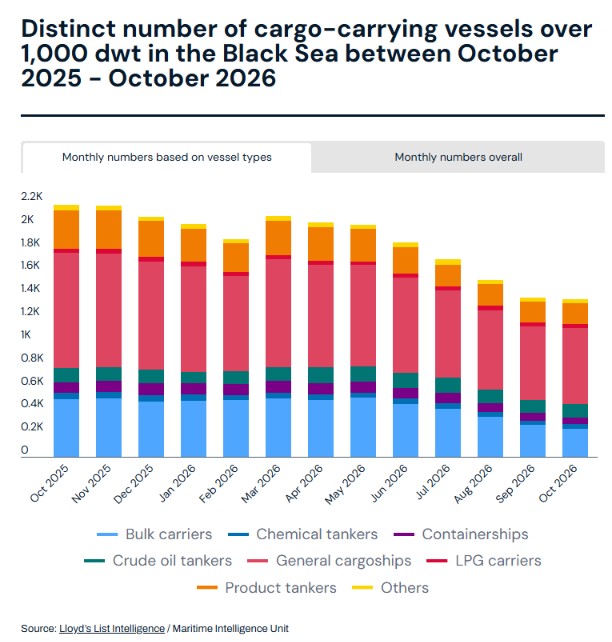
According to Lloyd’s List Intelligence, shipping activity in the Black Sea has fallen continuously since March 2026.
At that time, 2,091 cargo vessels with a deadweight tonnage exceeding 1,000 tonnes were operating in the waters of the six Black Sea countries. By October, that figure had dropped to 1,370.
The decline accelerated in August, when monthly shipping activity decreased by more than 10%.
Over a 24-day period in October, drones struck nine merchant vessels and tankers near the coasts of Bulgaria and Romania. At least 30 sailors were killed or reported missing. The attacks also affected ships transporting Ukrainian agricultural products. In early October, a Russian drone struck the Turkish vessel Royad Mammadov, which was carrying Ukrainian maize. The ship sank near a Romanian offshore platform, killing two crew members.
The growing security threats now affect not only Ukrainian ports and export routes, but also international commercial shipping across the western Black Sea. Following a series of incidents, NATO announced enhanced maritime surveillance, while Bulgaria and Romania requested additional satellite intelligence to monitor security conditions in the region.
Rising transport costs have become another serious challenge for Ukrainian exporters. In October, freight rates for shipping maize from the Danube ports of Odessa region to Egypt reached approximately $100 per tonne, more than three times the $30 recorded in July.