

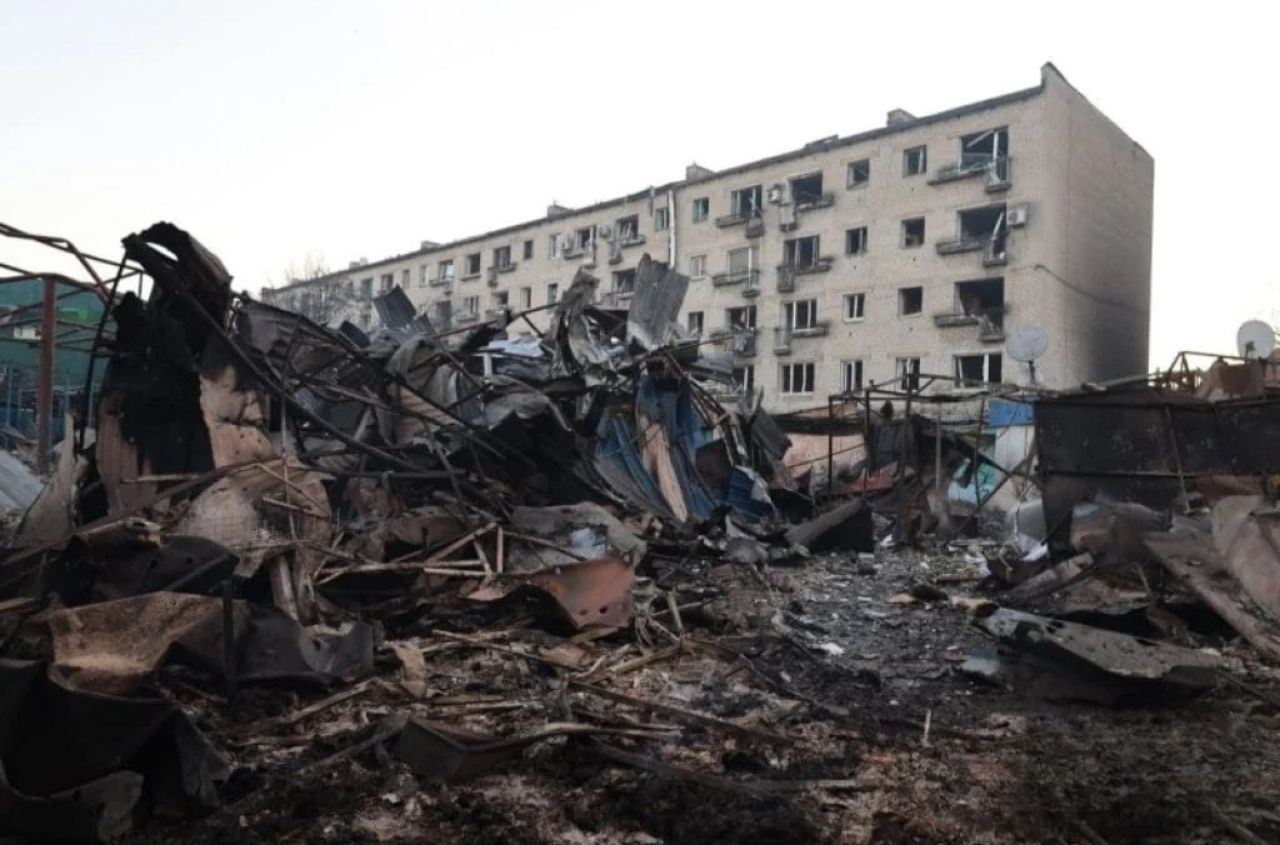

As for the future development of the situation in the Dobropillia direction, I would highlight several operational-tactical factors, namely:
- The “sleight of hand” involving part of the forces of the 41st Combined Arms Army, which were redeployed to the right flank by the Russian Centre Group of Forces command in early autumn, has clearly produced results quite different from those anticipated. In theory, these forces should ALREADY have accomplished their two main objectives: breaking through from the southwest into the Novomykolaivka–Novohryhorivka–Raiske–Torske area and cutting the Dobropillia–Kramatorsk road near Novotroitske and northwest of Zolotyi Kolodiaz. This would have enabled both Russian groups of forces (Centre and South) to dramatically accelerate the overall Sloviansk–Kramatorsk offensive operation.
Instead, the redeployed forces have become bogged down in exhausting meeting engagements around Toretske and are unsuccessfully attempting to advance northwards through Vilne and from the direction of Shakhove. The element of surprise, which initially accompanied the sudden and sharp increase in activity by these units along the designated axes, has clearly worn off. The Ukrainian Armed Forces have successfully thwarted their infiltration attempts towards Novomykolaivka, Pavlivka and Novopavlivka (that is, towards Druzhkivka). At present, Ukrainian forces are also proving fairly effective in blocking their northward advance towards the T-0514 road in the Zolotyi Kolodiaz–Kucheriv Yar–Vilne–Stepy area.
- On the other hand, this redeployment did bring certain advantages for the Russian command. It allowed the Centre Group of Forces to consolidate the operational deployment of its 51st Combined Arms Army and concentrate its troops and resources exclusively on the Ukrainian defensive area around Dobropillia. This quickly affected the situation southeast of Dobropillia: Russian forces managed to conclude the fighting for Bilytske in their favour and advance from the south and southeast to the immediate outskirts of Dobropillia.
Given that the Russian Centre Group of Forces and the troops on the left flank of the South Group of Forces remain the only formations making any meaningful progress in the entire Russian Sloviansk–Kramatorsk offensive operation, it is reasonable to expect that they will receive further reinforcements.
The question, however, is where exactly the resources for such reinforcements could realistically come from. That is a subject for an entirely separate discussion.
- The next factor worth considering is the range of possible courses of action available to the Russian Centre Group of Forces command during what appears to be an imminent assault on Dobropillia.
It is now clear that the Centre Group of Forces command failed to break into the city with substantial numbers of assault infantry immediately after its forward units reached the outskirts of Dobropillia. That is already an established fact. This means that the assault will have to proceed systematically and gradually, through the infiltration and accumulation of Russian assault infantry inside the city itself.
In this context, two highly probable elements of the operation will be attempts to envelop the city from the flanks and cut off its lines of communication from the north and northwest, as well as from the direction of Kramatorsk.
In my view, in the very near future, Russian forces will attempt to bring the areas around Sviatohorivka and Hannivka under their control — if not physically, then at least through intensive fire control — and break through towards Hruzke and Novotroitske.
At the same time, the Russian command will probably attempt to completely block the roads leading from Bilozerske using drones and artillery, potentially supplemented by extensive remote mining. The next stage would involve intensive infiltration into the city itself.
- Another factor is undoubtedly the possibility — or probability — of active Ukrainian resistance to these Russian plans. In my view, the most effective option in this regard would be counterattacks by the Ukrainian Armed Forces against the flank of the Russian grouping deployed in the Dobropillia direction. For example, Ukrainian forces could advance to the Vasylivka–Hryshyne line or even break through to the western outskirts of Pokrovsk, which currently serves as the main logistics and supply hub for Russian troops operating near Dobropillia, particularly the Russian 2nd Combined Arms Army. In this context, it is worth noting that the Ukrainian forward positions are less than 7 kilometres from the western outskirts of Pokrovsk.
Recent actions by the Russian command in the sector held by its 41st Combined Arms Army indicate that it not only recognises this threat but is also seeking to eliminate it pre-emptively by pushing Ukrainian forces as far west of Pokrovsk as possible.
The problem, however, is that the Russian command clearly does not fully appreciate the scale and number of such threats THROUGHOUT the entire operational area of its Centre Group of Forces. The Ukrainian Armed Forces have repeatedly demonstrated their ability to act unconventionally in this regard, even with relatively small forces.
So far, the Russian command, preoccupied with its assault on Dobropillia, has identified only one of these potential threats in the Dobropillia direction. But this certainly does not mean that Ukrainian forces lack other opportunities to disrupt the assault through their own offensive actions.