

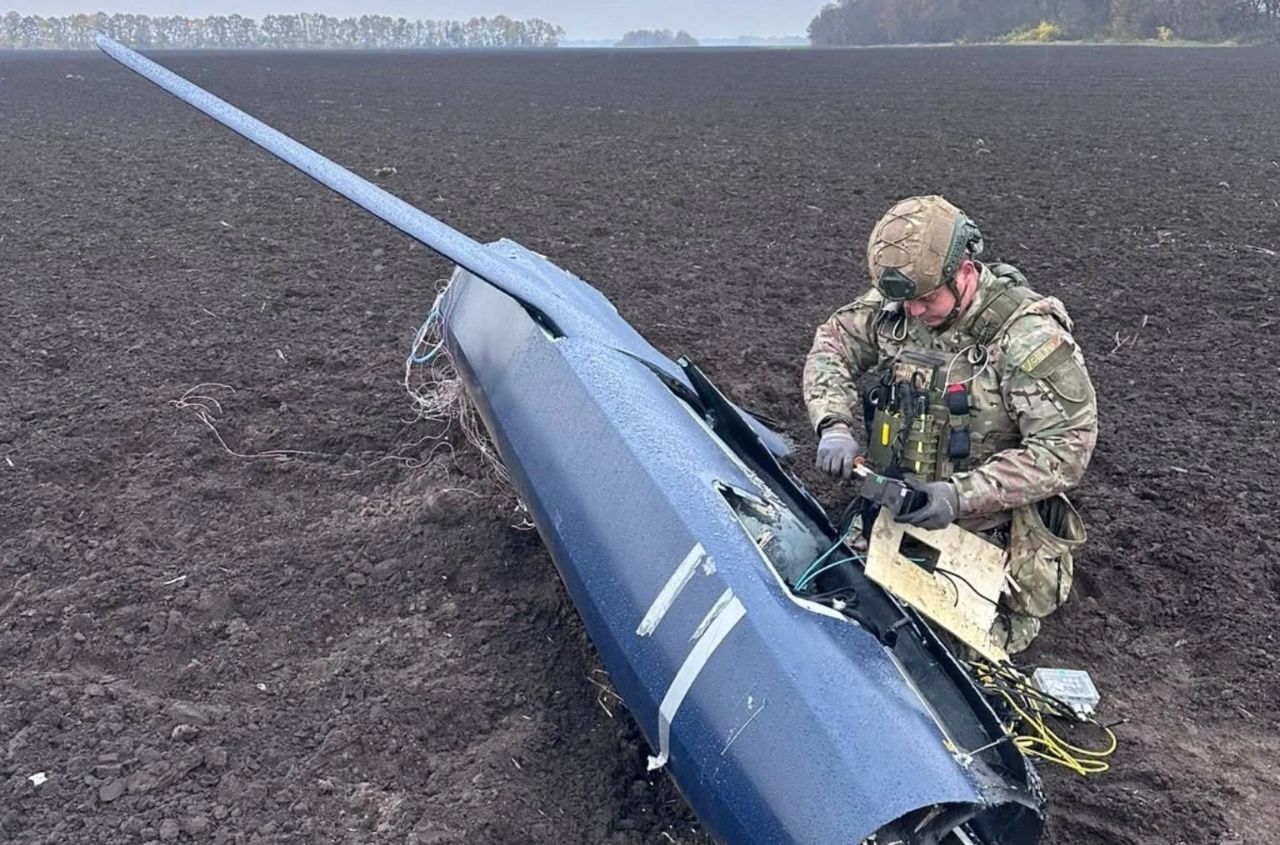

Main image: Ukrainian police explosives experts recovered the wreckage of a Russian Geran-5 drone in the Boryspil district of Kyiv region on November 1, 2026.
Investigators from Ukraine’s Prosecutor General’s Office have identified more than 16,000 foreign-made components in Russian drones, missiles and other weapons used against Ukraine.
The identified components bear markings from manufacturers in more than 30 countries. Parts manufactured by European companies in 2025 and 2026 have also been found in attack drones and missiles, once again raising questions about the effectiveness of export controls and sanctions, according to OCCRP.
According to the Defence Intelligence of Ukraine (DIU), the War & Sanctions platform contains information on more than 6,300 foreign-made components found in Russian weapons.
A Geran-4 jet-powered drone shot down near Kyiv in August 2026 contained a microcontroller manufactured by Swiss semiconductor company STMicroelectronics and dated February 2026. The Geran-4 is a faster and more manoeuvrable variant that Russia began deploying in May 2026, following the widespread use of Geran-2 drones against Ukraine’s energy infrastructure.
The same drone contained a transistor bearing the markings of Germany’s Infineon Technologies, dated June 2025. Another downed Geran-4 contained a chip manufactured by Britain’s Future Technology Devices International (FTDI), dated July 2025, which enables data exchange between the drone and a computer.
OCCRP’s partners also examined photographs of eight SIM cards recovered from Russian drones that may have been used to improve navigation accuracy. Telecommunications operator Tele2 Lietuva confirmed that the prepaid Pildyk SIM cards had been purchased and activated in Lithuania in 2024, presumably before being resold through networks of intermediaries.
Recently manufactured European components have also been identified in Russian missiles. A component produced by Swiss company u-blox and dated October 2025 was found in an RM-48U missile, while connectors manufactured by Germany’s Harting Technology Group in January and March 2025 were discovered in a Russian short-range ballistic missile.
STMicroelectronics and u-blox stated that they comply with sanctions and do not supply products to Russia or Belarus. U-blox also blacklists customers found to be transferring technology to Russia.
Infineon described the component as “very likely counterfeit”, while Harting representative Julian Fieres noted that connectors from civilian equipment, including computers, circuit boards and control cabinets, can be removed and repurposed for use in weapons, making them virtually impossible to trace.