


China has become one of the key pillars of the Russian war machine, but this support is simultaneously making Moscow increasingly dependent on Beijing. This is stated in a report by the Center for European Policy Analysis.
The authors note that after Russia’s full-scale invasion of Ukraine, Western sanctions were expected to weaken the Russian economy and limit Moscow’s ability to wage war. However, Russia has managed to partially adapt thanks to a sharp deepening of economic and technological ties with China.
According to the report, China has become a channel for Russia to bypass sanctions pressure: it purchases Russian energy resources and supplies industrial goods, equipment, electronics, and dual-use components necessary for the Russian military-industrial complex.
The technological dimension has been especially important. After access to Western technologies was restricted, China became the main external source of microchips, machine tools, navigation equipment, telecommunications components, and other critically important goods.
The report states that by 2023, Chinese suppliers were covering 70% to 90% of Russia’s import needs in several priority categories, including machine tools, bearings, navigation equipment, and basic semiconductors.
These goods are not finished weapons, but they are essential for producing drones, missiles, armored vehicles, communication systems, and other military equipment.
At the same time, Beijing avoids direct arms deliveries and seeks not to assume the risks of being a full-fledged ally. The authors describe this model as “calibrated assistance”: China helps Russia maintain its ability to wage war, but does not provide unconditional support.
Moscow’s economic dependence is also reflected in the structure of trade. Russia supplies China mainly with energy resources and raw materials, often at discounted prices, while China exports higher value-added goods to Russia—cars, electronics, industrial products, and equipment.
According to the authors’ assessment, this model locks Russia into the role of a junior and dependent partner. Moscow gains short-term resilience under sanctions but is simultaneously becoming increasingly embedded in China’s economic and technological orbit.
Beijing’s financial support also has limits. Although settlements in rubles and yuan have increased sharply, Chinese banks remain cautious about transactions that could trigger the risk of secondary sanctions. China has not granted Russia full access to its financial markets and has not replaced Western investment.
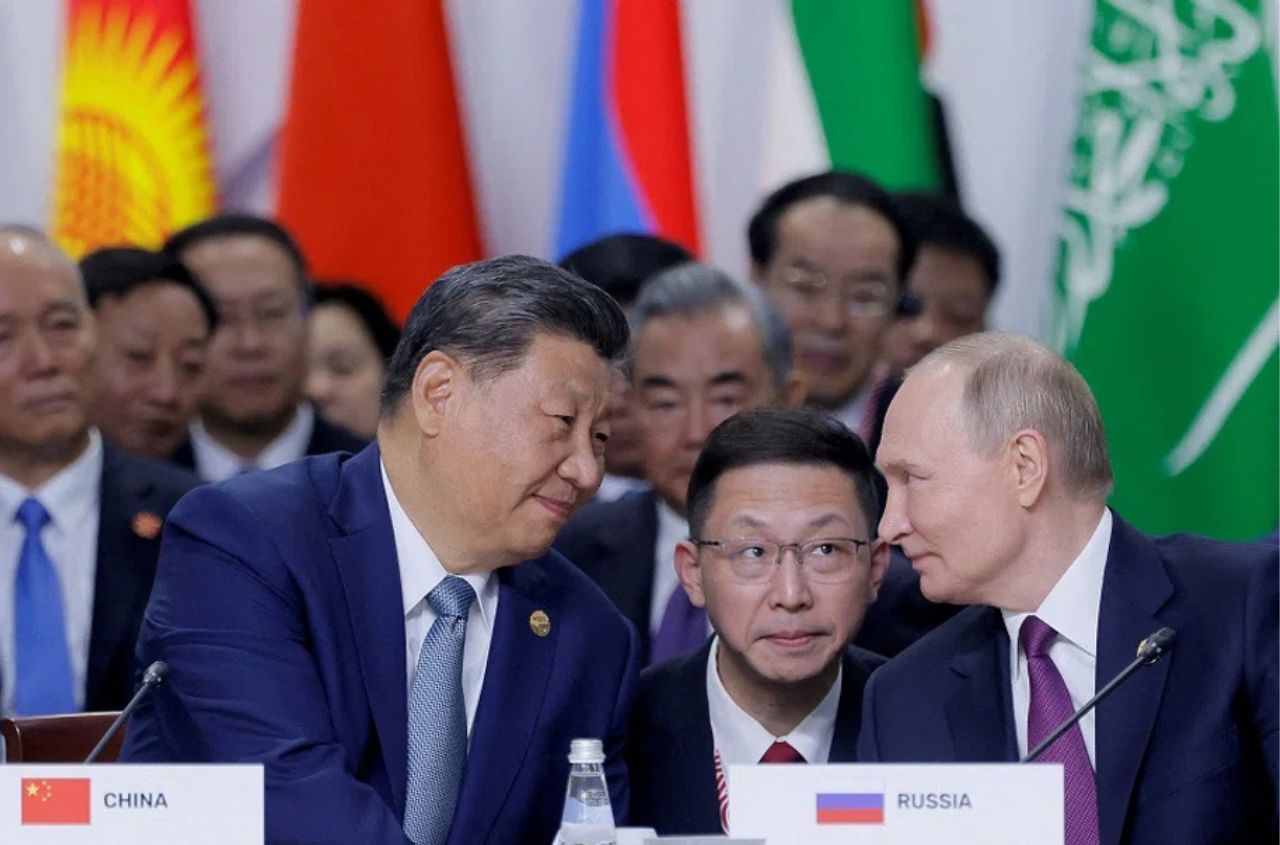
In the military sphere, Moscow and Beijing demonstrate rapprochement through joint exercises, patrols, and military-technical cooperation. However, the authors emphasize that this is not an alliance modeled on NATO: Russia and China do not have a shared command system, collective security guarantees, or a willingness to fight for one another.
The report’s main conclusion is that China is not simply helping Russia survive sanctions. It is sustaining Moscow’s ability to continue the war against Ukraine while simultaneously increasing its own leverage over Russia.