


By Viktor Yahun
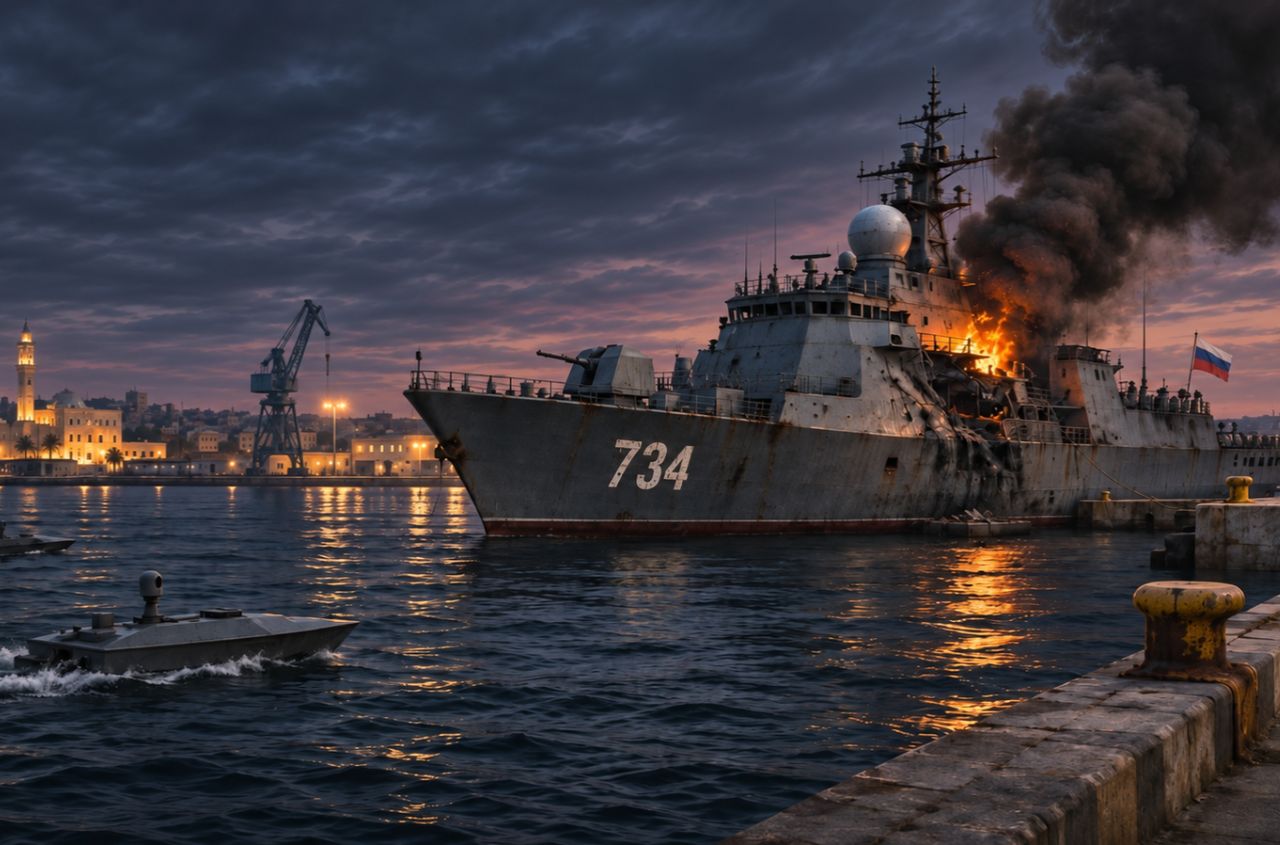
On 22 November 2026, a powerful explosion occurred at a naval base in the Libyan port of Benghazi. Initially, local emergency services reported an ammunition detonation. However, the eastern Libyan government, formed by the House of Representatives, subsequently issued an official clarification: according to preliminary findings of the investigation, the explosion occurred aboard a Russian vessel moored in the port. An attack involving unmanned systems is among the main possibilities being investigated. According to the Libyan authorities, the Russian ship had entered Benghazi to replenish its fuel and supplies before returning to Russia.
It is important here to distinguish established facts from preliminary assumptions. The explosion aboard a Russian vessel has been confirmed by an official statement from the Libyan authorities. However, the method of attack, those responsible and the final extent of the losses remain undetermined. Reuters, citing medical sources, reported injuries, but there is no confirmed information about fatalities. The eastern Libyan authorities stated that the fire had been brought under control, that port infrastructure had not sustained significant damage, and that the circumstances of the incident would be investigated jointly with the Russian side.
Of particular interest is the identification of the vessel. The specialist publication Naval News and OSINT researchers have provisionally identified it as the Merkury, a Project 20380 Steregushchiy-class corvette. Published footage of the explosion and satellite imagery indicate a major fire. According to assessments by some naval analysts, the vessel may have sustained critical damage and effectively been lost. The Ukrainian defence publication Militarnyi reports that the fire engulfed the stern and part of the ship’s midsection.
However, there has been no official confirmation of the vessel’s identity, its sinking or its permanent withdrawal from service. It would therefore be premature to claim that a specific warship has definitely been destroyed. In military analysis, it is essential not to substitute desired conclusions for verified facts.
If the vessel was indeed the Merkury, the potential losses to the Russian Navy would extend far beyond a single damaged hull. The Merkury is a modern missile corvette commissioned into the Russian Navy in 2023, with a displacement of approximately 2,200 tonnes and equipped with anti-ship missiles, air defence systems and anti-submarine warfare capabilities.
The corvette formally belongs to the Black Sea Fleet but has operated outside the Black Sea because of restrictions on the passage of warships through the Turkish Straits. According to Naval News, it had been in Benghazi for several days before the explosion and had been escorting Russian cargo vessels associated with military transport operations.
Why is Benghazi so important to Moscow? Libya has long been one of the key elements of Russia’s military and political presence in Africa. Cooperation with Khalifa Haftar’s forces in the east of the country enables Russia to maintain supply routes, move military equipment, personnel and materiel, and coordinate activities with partners in other African countries.
Within this system, ports and airfields have not only local but also interregional logistical significance. They support Russia’s presence in the Mediterranean and facilitate certain areas of Russian military activity across the African continent.
This is why even a single serious incident could force the Russian command to review its procedures for securing naval berths, escorting maritime convoys, protecting against sabotage and maintaining a naval presence beyond its traditional basing areas.
The internal Libyan dimension also deserves particular attention.
The eastern Libyan government described the possible attack as a violation of state sovereignty and promised appropriate legal and diplomatic measures. Meanwhile, the Government of National Unity in Tripoli emphasised that the deployment of foreign military forces and the use of Libyan ports for military logistics outside national government control pose a threat to Libya’s own security.
The Benghazi incident therefore immediately acquired broader political significance. It concerns not only an explosion aboard a Russian vessel but also the issue of foreign military presence, the de facto division of power and the authority to conclude military agreements on behalf of the Libyan state.
There is also a broader naval context.
In March 2026, the Russian gas carrier Arctic Metagaz was severely damaged in the Mediterranean Sea near Malta. In April, RFI and the Associated Press published reports citing Libyan sources concerning the possible involvement of Ukrainian specialists in the operation and their presence in western Libya.
The Ukrainian authorities have not officially confirmed this information. It would therefore be professionally inappropriate to automatically apply previous assumptions to the Benghazi incident and identify Ukraine as its organiser without sufficient evidence.
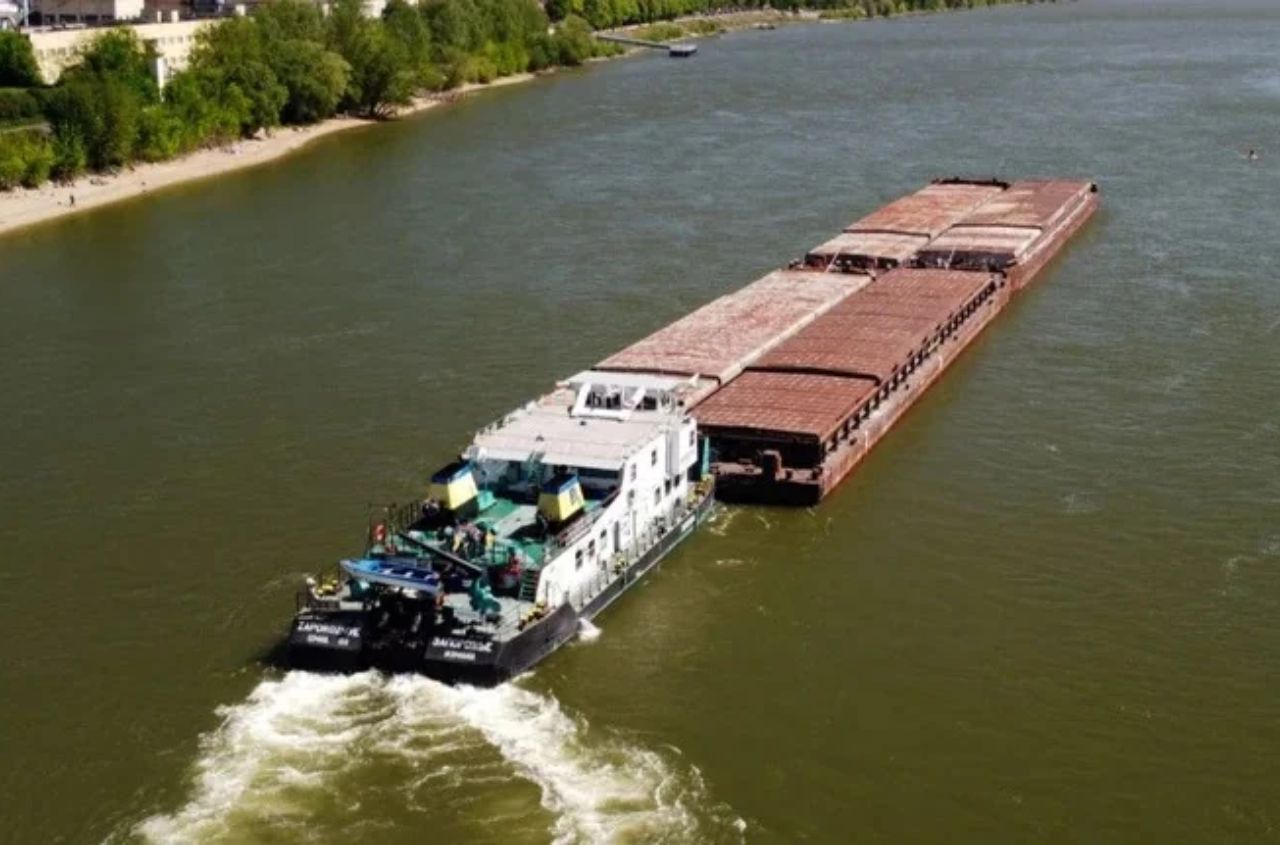
Meanwhile, on 21 November, the Russian cargo vessel Sparta II, linked to the company Oboronlogistika, caught fire in the Gulf of Finland following a suspected drone attack. Reports indicated that the crew had been evacuated and that emergency rescue operations were being carried out with the involvement of services from several countries.
This incident also demonstrates the vulnerability of maritime transport associated with Russia’s military logistics system. However, the timing of the two incidents does not, in itself, prove that they were coordinated, formed part of a common plan or involved the same perpetrators.
From a professional perspective, the central question concerns the changing nature of modern naval warfare.
A warship can no longer automatically be considered safe simply because it is located thousands of kilometres from the immediate theatre of operations. The development of unmanned systems, sabotage technologies, long-range strike capabilities and intelligence-gathering tools is fundamentally changing traditional assumptions about the security of naval bases and rear-area logistics routes.
If the theory of an external strike is confirmed, the Benghazi incident will demonstrate that Russian naval logistics have potentially critical vulnerabilities not only in the Black Sea but also in the Mediterranean region.
For Russia, this would mean additional expenditure on protecting port facilities, countering unmanned systems, providing counterintelligence support, identifying maritime threats and securing diplomatic cover for its military presence abroad.
At the same time, it is essential to distinguish a military assessment of the possible outcome from the incident’s classification under international law.
The incident occurred on the territory of a state that is not a party to the Russia–Ukraine war. The origin of the weapons used, the status of the target, the nature of the vessel’s activities, the circumstances of the possible attack and its implications under international law all require separate investigation.
For this reason, Russia’s military presence in Libya, the positions of the two Libyan administrations and the possible consequences of the incident for regional security must be considered interconnected elements of a broader strategic problem.
For Ukraine, the incident is significant primarily because it illustrates how modern warfare is transforming traditional concepts of the front line, the rear, the maritime domain and strategic lines of communication.
The true scale of the incident will be determined not by dramatic reports of a “sunken corvette”, but by verified identification of the vessel, an objective assessment of the damage, confirmation of the cause of the explosion and the subsequent behaviour of Russian naval forces in the region.
In my view, the strategic significance of such incidents lies in the fact that Russia’s military support system is increasingly confronted with the need to protect not only combat positions but also the distant infrastructure underpinning its global presence. The vulnerability of maritime lines of communication, limited security resources and dependence on foreign ports create additional risks for the functioning of this system.
Benghazi today is not merely an explosion in a military port. It is a test of the resilience of Russia’s military presence thousands of kilometres from Ukraine. At the same time, it is a reminder that, in modern warfare, the security of logistics does not end where the front line ends.