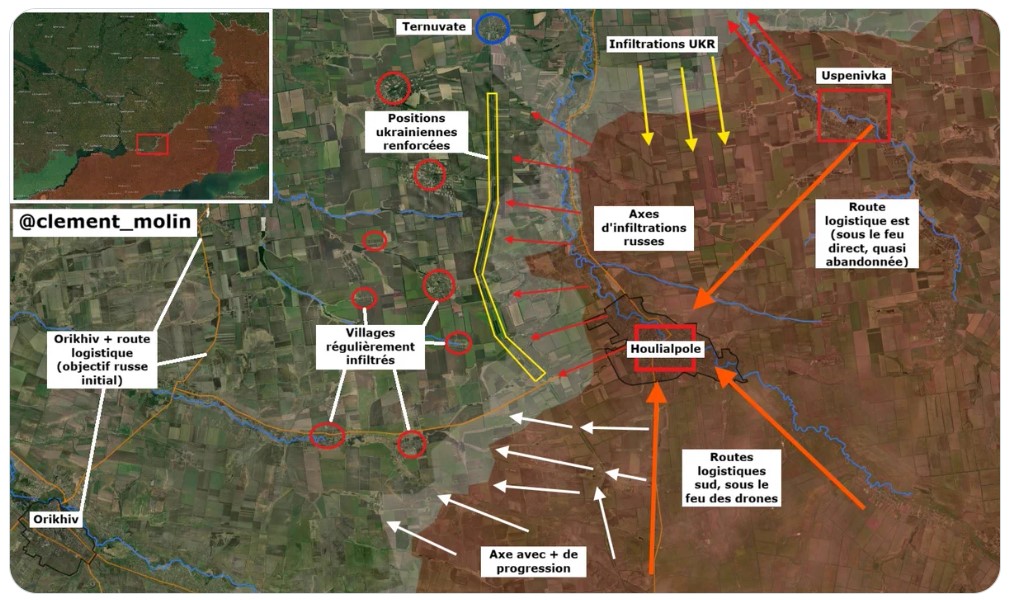



OSINT researcher Clément Molin notes the failure of the Russian offensive west of Huliaipole.
The number of Russian airstrikes has decreased from 500 every 10 days in May, to 350 in June, and fewer than 200 currently. The slowdown in this sector has actually been visible for several months, with the failure of the offensive toward the west.
This failure is explained by the inability to seize control of Ukrainian fortified positions on the western outskirts of Huliaipole, particularly along the railway line. In addition, the terrain is unfavorable for the Russians, who have to cross a river, then an anti-tank ditch and barbed wire obstacles. The Ukrainians, meanwhile, hold higher ground and control Ternuvate, which provides an unobstructed view over part of the region.
Russia’s ability to build up forces is very limited, with Huliaipole being the main focus (the town has been so heavily destroyed that its strategic value has significantly decreased). Its logistical routes are constantly under Ukrainian fire. Russian infiltrations, particularly by flag bearers who are sent on suicide missions so that the command can continue deceiving Moscow, have achieved nothing — none of the infiltrated villages are under Russian control.
At the same time, the Ukrainians have made the Russians’ task more difficult by carrying out infiltrations of their own (in some areas, this could even be described as gaining control) north of Huliaipole, reducing the window of opportunity for Russian infiltration attempts. The small town of Uspenivka is facing Ukrainian pressure from both sides.
However, it cannot be said that the Russian offensive has completely ended. While there have been no gains for several months, the area further south (marked by white arrows) has seen more sustained advances.
Overall, the entire southern front, stretching 175 km, is an area where the Russian position is far from optimal. The rapid advance of 2025 (45 km westward) has not continued in 2026, while the threat to Zaporizhzhia has been reduced. Ukrainians even have the advantage on half of this southern front.
The situation has, as expected, deteriorated, with a stronger Russian presence, but the city is still not under Russian control.