

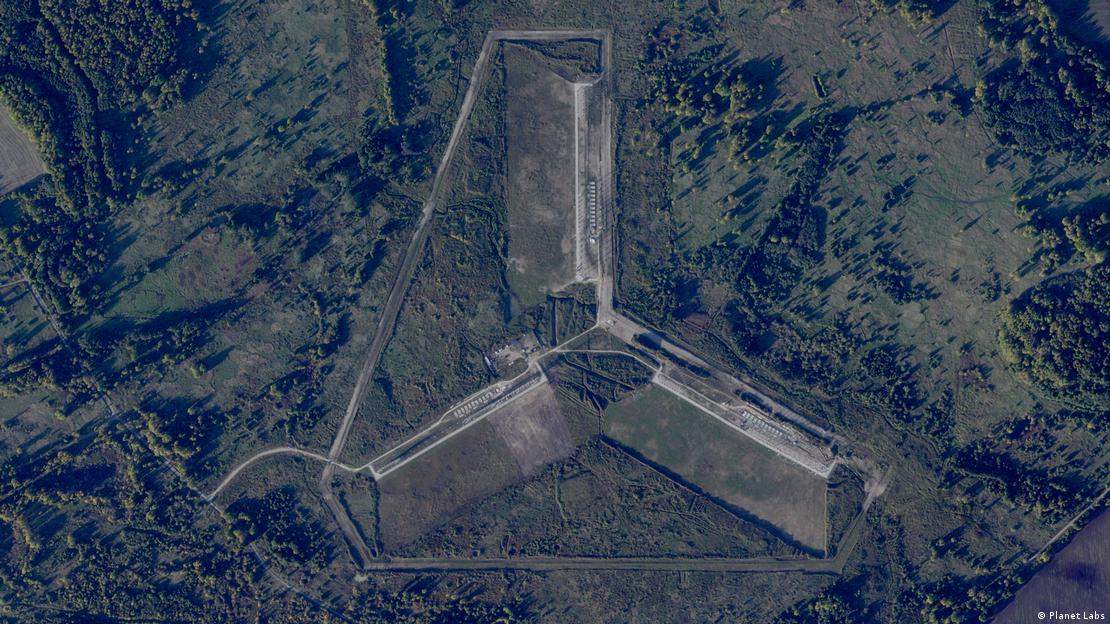

Main image: The radar near Gvardeysk would reportedly allow Russia to intercept satellite communications, detect aircraft movements and ballistic missiles. Planet Labs.
Russia is nearing completion of a large radar installation in its Kaliningrad exclave that could monitor military activity across Ukraine and much of Europe, potentially strengthening Moscow's surveillance capabilities along NATO's eastern flank.
According to Deutsche Welle, satellite imagery shows three beam-shaped antenna arrays near Gvardeysk, each extending more than 500 metres. Experts estimate the system could have an operational range of approximately 3,000 kilometres.
The installation is believed to be an over-the-horizon radar, designed to detect objects beyond the range of conventional radar systems.
Former Lithuanian military commander and security expert Vaidotas Malinionis said the facility could allow Russia to track aircraft movements, detect ballistic missiles and monitor NATO military activity.
"The goal and the purpose of this radar is observation of long-distance targets and early warning capabilities. We still don't know if it is operationally capable of doing that, but it is definitely being constructed right now," Malinionis added.
British newspaper The Times, citing satellite intelligence company ICEYE, previously reported that similar installations may also be used to detect and disrupt electronic signals.
Kaliningrad, situated between Poland and Lithuania, occupies a strategically important position on NATO's eastern flank. A long-range radar installation there could provide Russia with earlier warning of military movements and additional time to respond.
Satellite analysis has also identified another large circular antenna installation near Chernyakhovsk, approximately 50 kilometres west of Gvardeysk, according to Frankfurter Allgemeine Zeitung.
Other recent developments in the exclave include new fighter aircraft shelters at Kaliningrad-Chkalovsk airbase and S-400 air defence missile positions near Baltiysk.
The expansion comes amid longstanding concerns over Russian electronic warfare activity in the Baltic region, including reported interference with European satellite navigation systems.