


By Viktor Yahun
Over the past few weeks, so many military, sabotage, cyber and infrastructure-related signals have accumulated around the Baltic Sea that it is no longer appropriate to consider each of them separately.
Let us start with Narva.
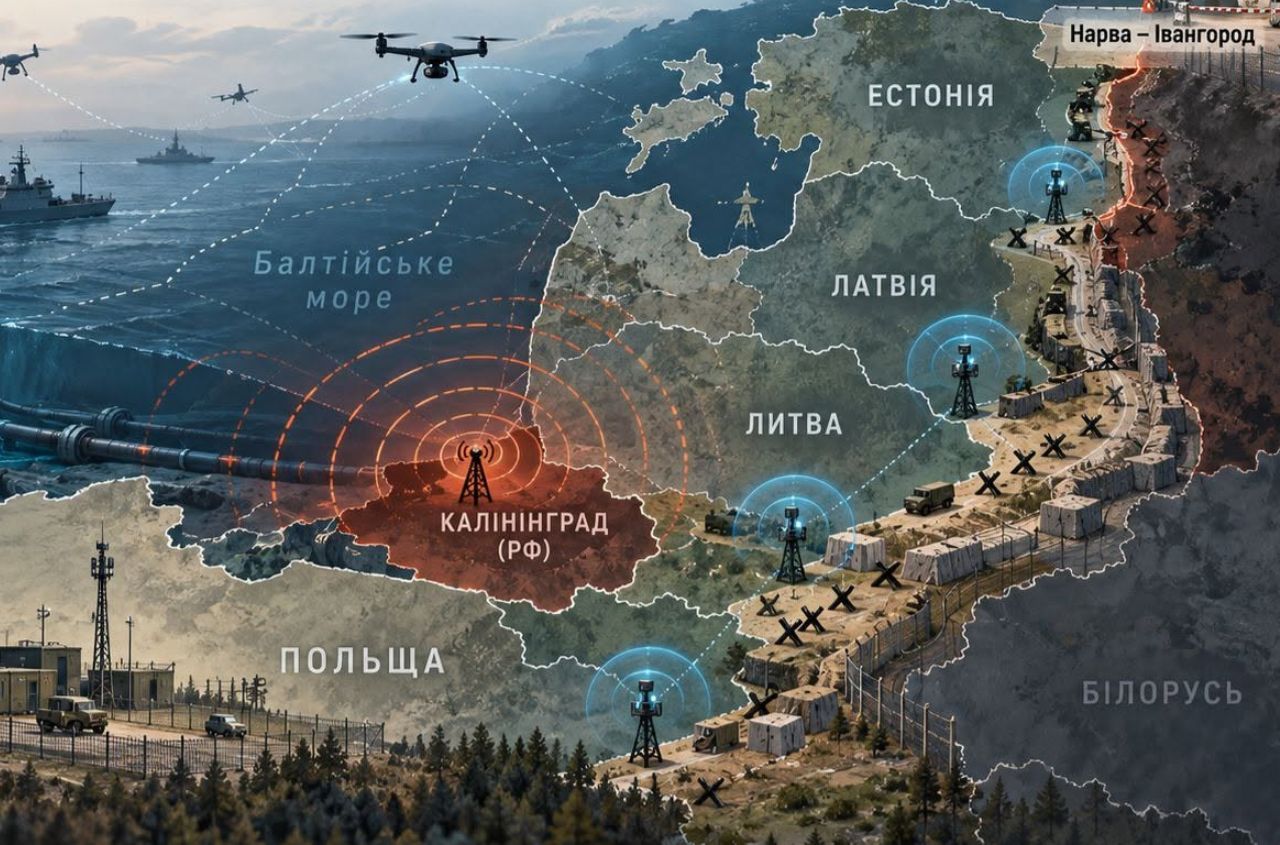
From 16 to 26 September, the FSB imposed additional restrictions in the Kingisepp and Slantsy districts of the Leningrad region — effectively directly opposite Estonia. In the five-kilometre border zone, restrictions were imposed on night-time movement, hunting, carrying weapons and the movement of small vessels along part of the Narva River. At the same time, Estonian border guards have observed Russia strengthening infrastructure along its bank of the Narva and generally expanding its ability to control the border area.
At the same time, an important point: there is no evidence that these measures served as cover for the deployment of a strike force. But in the broader context, they demonstrate something else — Russia is once again practising its ability to rapidly seal off border areas, restrict civilian movement and establish strict control over the operational space.
On the other side of the border, governments are no longer limiting themselves to statements either.
Lithuania is creating counter-mobility lines, expanding its network of engineering parks with defensive obstacles and working to use marshlands as natural barriers. Poland is implementing its Tarcza Wschód programme, while Estonia and Latvia are building their own elements of the Baltic Defence Line. NATO is strengthening its eastern flank — from ground forces to air defence, intelligence, surveillance and counter-UAV systems.
At the same time, another war is underway — an electromagnetic one.
According to the Lithuanian regulator, the number of antennas belonging to Russia’s GPS-spoofing infrastructure in the Kaliningrad region has increased from around three to 36 since the beginning of 2025. The estimated area of impact extends up to 450 kilometres, covering the Baltic Sea, a significant part of Poland and parts of Finland and Sweden.
Around Gdańsk, GNSS disruptions have become systematic. In May and June, significant interference lasting several hours was recorded on approximately 70% of days. During the first 19 days of August, the figure was 63%. On 21 August, even the Polish naval vessel ORP Albatros experienced GPS problems during operations in the Baltic Sea.
Then there is the drone dimension.
On 15 September, a NATO fighter shot down an explosive-laden UAV over Lithuania that had entered from Belarus and, according to preliminary assessments, was of a type used by Russia. On 21 September, Poland once again scrambled combat aircraft in response to Russian strikes on Ukraine. On 24 September, Finnish and Swedish fighters carried out their first joint interception of a group of Russian military aircraft over international waters in the Gulf of Finland.
The three Baltic states have already asked the EU for an additional €500 million to strengthen their counter-drone defences. The European Commission confirmed receiving the request and said on 25 September that it was “carefully examining” it. Meanwhile, the Netherlands has extended the deployment of MQ-9 Reapers for reconnaissance missions along NATO’s eastern flank until the end of 2027.
There is another revealing dimension: preparations behind the front line.
Lithuania is practising how the state would function under mobilisation conditions: banks must ensure that payments can continue even if internet access and electricity supplies are lost. On 22 September, the Seimas supported further consideration of a constitutional amendment that would remove the prohibition on weapons of mass destruction. This does NOT mean that nuclear weapons will be deployed: the procedure has not been completed. But the direction of the debate itself is significant.
At the same time, France has agreed to begin talks with Latvia on its participation in the French nuclear deterrence initiative.
And now comes perhaps the most interesting part.
On 23 September, a Starlink ground station caught fire in Poland. Polish prosecutors are investigating the incident as possible sabotage and a crime committed on behalf of a foreign intelligence service. Prosecutors said there were reasonable grounds to suspect possible involvement by Russian intelligence services. There has been no definitive attribution yet, but both the target and the nature of the incident fit very closely into the logic of hybrid warfare against critical infrastructure.
So what follows from all of this?
For now, there is no confirmation that Russia is assembling forces for a direct offensive against Narva, the Suwałki Gap or any other NATO territory. Estonian security services have explicitly stated that they currently see no signs that Russia intends to launch a military attack against an Alliance member state.
At the same time, they are equally explicit about Moscow’s long-term ambition to destabilise Europe, intimidate it and force it to reduce support for Ukraine.
And this is the key point today.
You do not necessarily need to send tanks towards Narva to create a crisis on a NATO-wide scale.
GNSS can be jammed. A cable can be damaged. An energy system can be attacked. An attempt can be made to disable Starlink. A border can be overwhelmed through migration pressure. A drone can be launched within a “grey zone” of attribution. At the same time, a cyberattack and an information operation can be conducted while the level of nuclear intimidation is raised.
Russia has either already used each of these tools or has the capability to use them.
That is why today I would not speak about an inevitable “Russian attack on the Baltics,” but about a much more complex and potentially more dangerous construct.
Russia is developing, refining and testing a set of tools that would allow it, at a chosen moment, to create a controlled multi-domain crisis on NATO’s eastern flank — military, sabotage, electronic, cyber and information operations unfolding simultaneously.
And NATO, judging by Baltic Sentry, Eastern Sentry, the construction of fortifications, the deployment of counter-drone systems, mobilisation exercises and the strengthening of its military presence on the eastern flank, appears to be preparing for precisely such a scenario.
So there is no war in the Baltic today.
But the space in which one could begin is already being actively prepared — by both sides.