

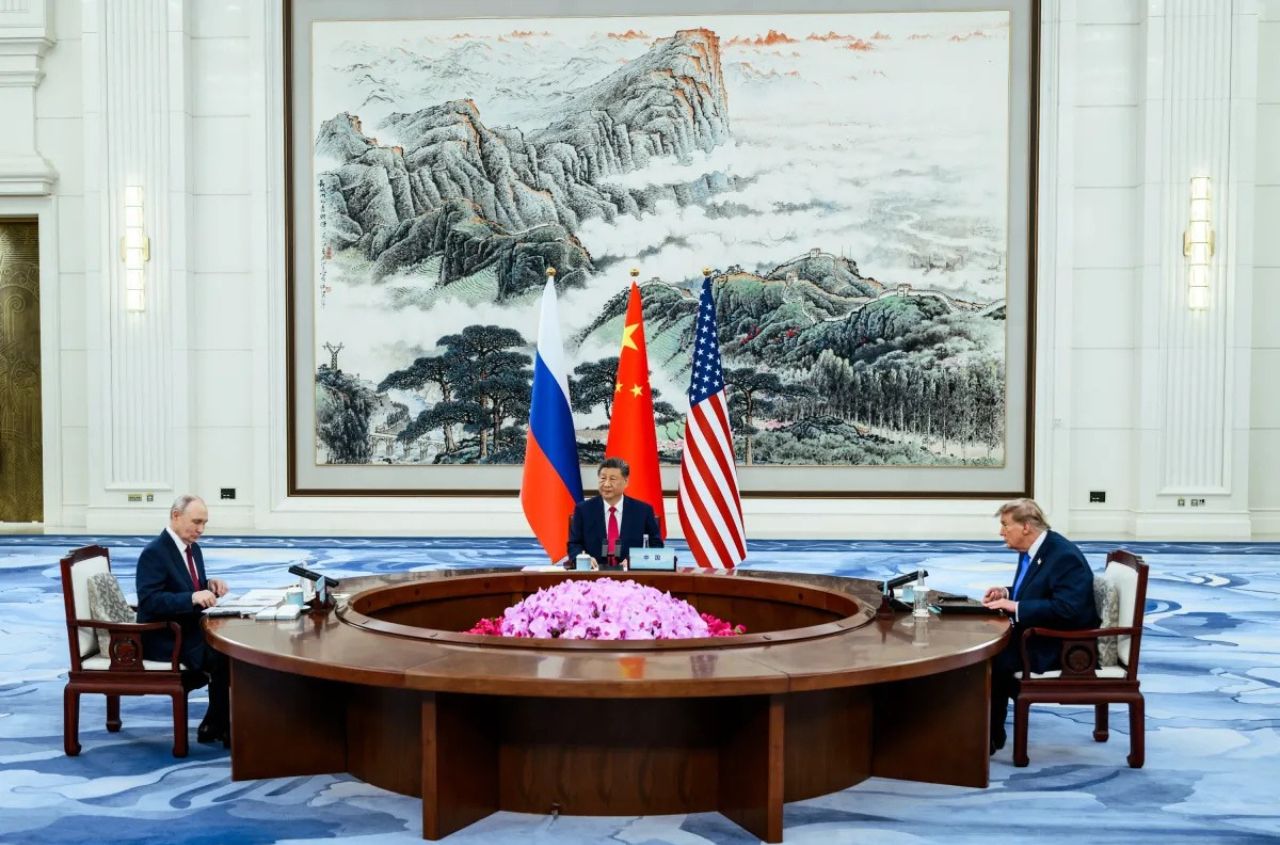

Former Italian ambassador Michele Valensise on what Xi Jinping gained from the three-way talks, why Ukraine needs a seat at the negotiating table and how Europe can make its voice heard.
Interview by Claudia Flisi
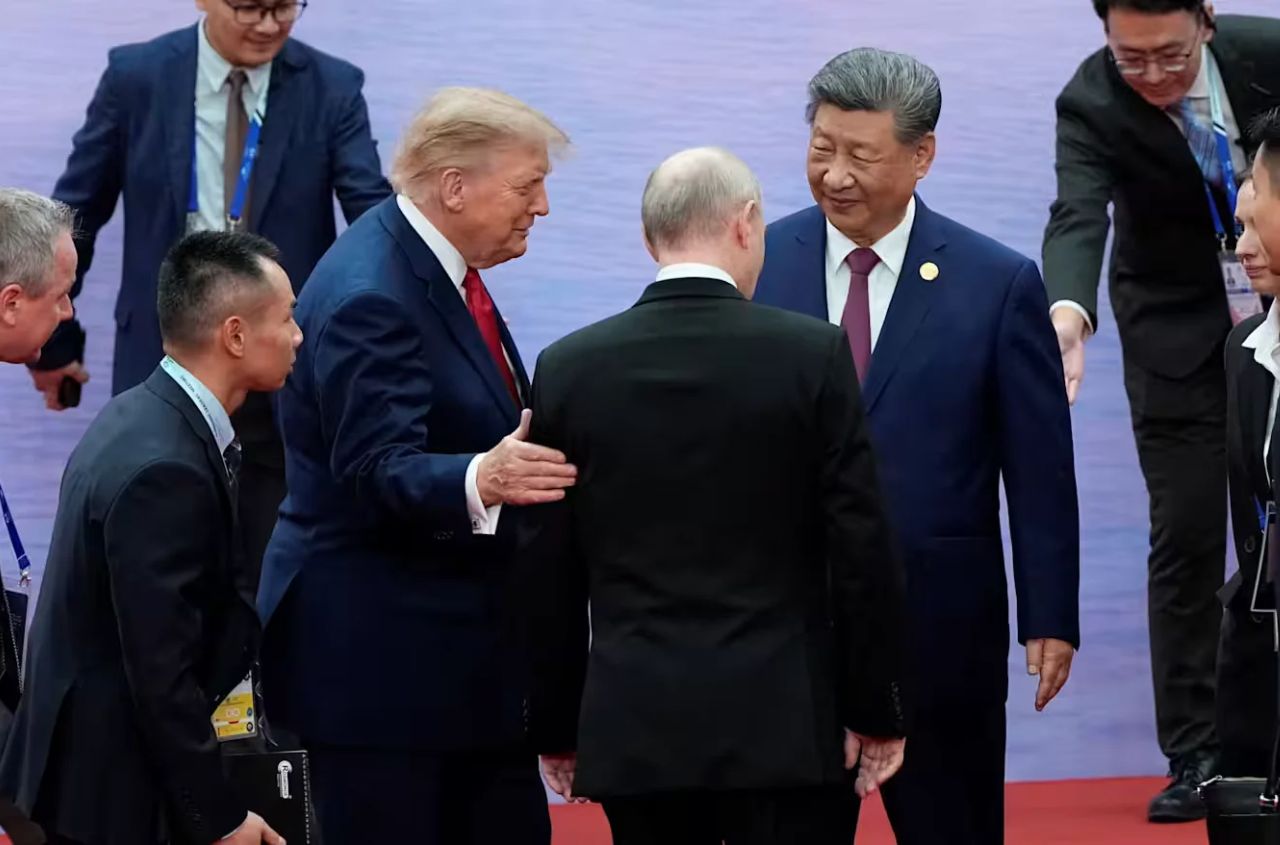
When China’s Xi Jinping brought US President Donald Trump and Russian President Vladimir Putin together on the sidelines of the Asia-Pacific Economic Cooperation (APEC) Leaders’ Meeting in Shenzhen on 19 November 2026, the encounter drew comparisons with Yalta.
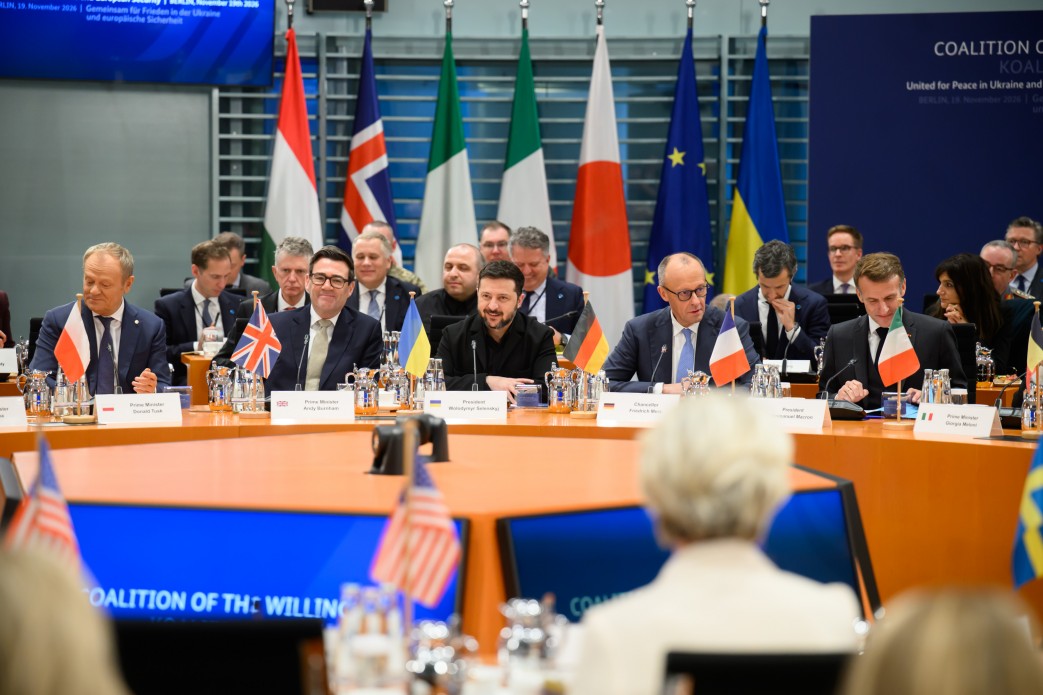
That same day, Ukraine’s allies met in Berlin to coordinate their support for Kyiv. For Michele Valensise, the two meetings raised a question for Europe: how much influence is it prepared to exercise over decisions that affect its own security?
Valensise, now president of the Rome-based Istituto Affari Internazionali (IAI), served as Italy’s ambassador to Germany from 2009 to 2012 and as secretary general of the Italian Ministry of Foreign Affairs from 2012 to 2016. He spoke to Claudia Flisi, a freelance journalist based in Washington, D.C., on behalf of the US-Italy Global Affairs Forum, in cooperation with Johns Hopkins University in Bologna.
Xi Jinping, Donald Trump and Vladimir Putin met on the sidelines of APEC in Shenzhen. Some compared the encounter to Yalta. How far does that comparison hold?
The expectations were understandably high. These three leaders had never met together in this format before. At Yalta in February 1945, Stalin, Churchill and Roosevelt shared the prospect of victory over Nazi Germany. In Shenzhen, the three leaders came to the table from very different positions.
Trump was weakened by the midterm elections and by a decline in his popularity that had begun before the vote. Putin is stuck in a war that has lasted nearly five years, at a terrible human cost. He thought he could achieve his aims in days or weeks. Russia still does not control all of the Donbas territory it claims to have annexed.
Xi, meanwhile, projected confidence. China has problems of its own, but Xi presented himself as a leader who could bring the others together and help shape a new world order. For him, hosting the meeting was an achievement in itself.
Did the three-way meeting produce anything that points to a new global order?
I would be cautious. The three leaders’ declaration touched on UN reform, the flow of energy supplies, a challenge to the role of international courts and the possibility of reducing nuclear arms. These are significant subjects, but the declaration set no deadlines or concrete steps for putting those broad principles into practice.
The question for Europeans is what we do about this format. Matters of global consequence cannot be left to China, Russia and the United States alone. Europe has room to act if it has the political will.
The Coalition of the Willing met in Berlin on the same day to discuss support for Ukraine. What did that meeting achieve?
It showed that Ukraine’s partners are still paying attention and can coordinate their response. Italy played an important role alongside its allies. That mattered all the more given the reports that Trump, after the Shenzhen meeting, had urged the coalition to stop supporting Ukraine. I think that was an unfortunate intervention.
What is at stake goes beyond a piece of territory. It is about respecting international borders, refraining from the use of force to settle disputes and honouring agreements. Europe and the United States should work together to bring the war to an end and persuade Russia that continuing it carries an enormous cost, including for Russia itself. That requires serious negotiations with Ukraine at the table. Its interests must be central because it is the country that was attacked.
You served as Italy’s ambassador to Berlin. How much room does Chancellor Friedrich Merz have to lead on European defence?
Merz faces domestic difficulties. There are tensions with the Social Democrats in his coalition, and the rise of the far-right Alternative for Germany is a concern across the country, including in the west. Even so, he understands the challenge Germany faces and is committed to rebuilding defence capabilities that were neglected for years.
Germany, like other Atlantic allies, became accustomed to relying on the United States for its security. That assumption has changed. Germany has the financial means to invest on a scale few European countries can match, and I think there is broad public support for doing so. Defence includes protecting airports, communications networks and other civilian infrastructure. Germans understand that those systems are vulnerable.
Giorgia Meloni has backed Kyiv while declining to commit Italian troops to a possible deployment in Ukraine. Does that weaken Italy’s role in the coalition?
A deployment remains hypothetical, and Russia rejects the presence of foreign forces on Ukrainian soil. Germany, too, is cautious about sending troops as part of a stabilisation mission or a security guarantee. That has not prevented Berlin from working closely with Britain and France and putting forward its own proposals. Italy can do the same. It should state its reservations openly and continue working with its European partners.
I think Meloni has taken a wise course. Her government has consistently supported Ukraine and recognised it as the victim of aggression. That support should help create the conditions for serious negotiations over Ukraine’s future, including the Donbas. It takes two to tango, and it takes two to negotiate. So far, I have seen no sign that Russia is ready for serious talks.
How should Europe deal with a politically weakened Trump after the US midterms? Can the new Congress change Washington’s approach to Ukraine or trade?
Congress has influence, but the president still has considerable room to act in foreign policy, including through executive orders. We will see whether the new political circumstances make Trump more flexible or more rigid and unpredictable. A deeper US disengagement from Ukraine is one possibility.
Europe should continue to regard the United States as an essential ally and be willing to make its case firmly. Greenland is an example. In my view, a united European response helped persuade Trump to set aside the most drastic options and take a more pragmatic approach.
The debate over European defence often comes down to spending targets. What should European governments focus on?
Europeans increasingly understand that they cannot rely on the security arrangements of past decades. This goes back well before Trump. Barack Obama was already asking Europeans in 2014 to take greater responsibility for their own defence.
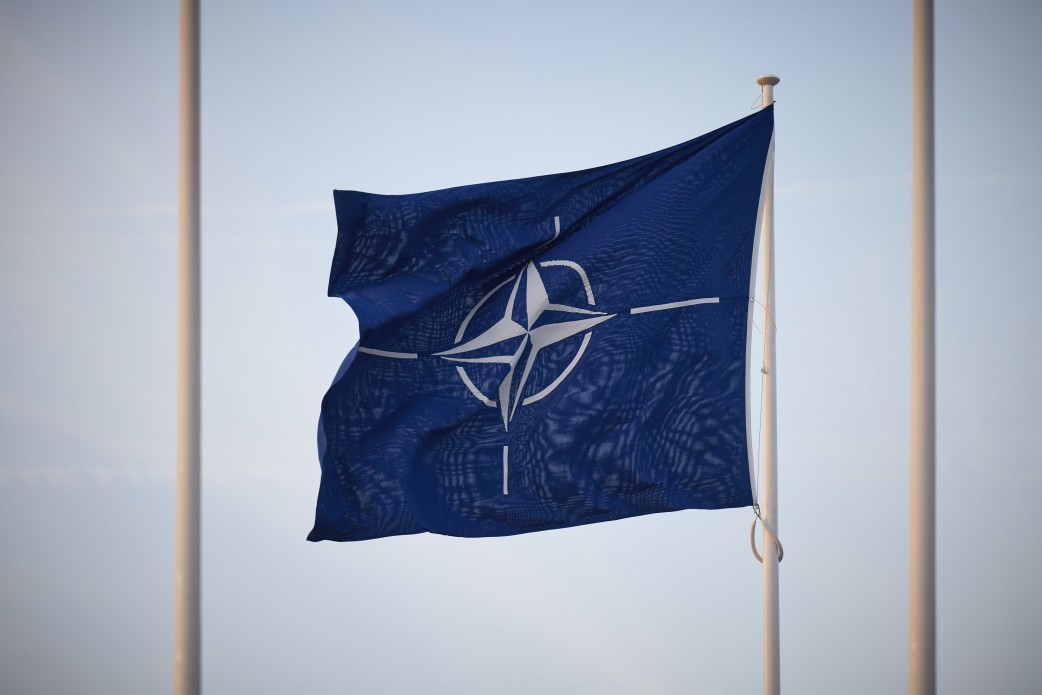
Percentages are easy to communicate, but I would start by asking what capabilities Europe needs. We should coordinate defence production and supply chains, avoid duplication and agree on a better division of labour. Higher spending alone cannot achieve that. Coordinating among 27 EU countries is harder than making decisions at federal level in the United States, but that is the direction Europe needs to take. I expect European allies to honour their NATO commitments.
The IAI’s annual report discusses ‘interest-driven multilateralism’. What can middle powers such as Italy and Canada do when the largest powers increasingly set the agenda?
Multilateralism is under strain. The United States has withdrawn from a number of international bodies, many of them within the UN system. If countries conclude that they can settle disputes by force whenever it suits them, only a handful have the means to do so. The result would be a more disorderly and unjust world.
The answer is to rebuild cooperation around rules countries see as serving their own interests. Respect for sovereignty and national borders is fundamental. That is why I take seriously the appeal of Canada’s Mark Carney and the role that middle powers can play.
European countries and Canada should look beyond their usual partners. The Global South is diverse. Many governments have reservations about the West and are also wary of aligning themselves with authoritarian powers. There is room for a constructive dialogue based on shared interests, even where we see some issues differently.
What are your priorities as president of the Istituto Affari Internazionali?
Multilateral cooperation and European integration are at the top of our list. Many of the problems we face can be addressed more effectively at European level. The defence of human rights and development cooperation are also central to our work.
I want the institute to reach a wider public. International developments have an immediate impact on people’s lives. Our job is to help readers understand what is happening and give them the information they need to form their own views.
The conversation was organised by Daniele Moro, a journalist and executive director of the US-Italy Global Affairs Forum, and Giovani Cecina, a writer and historian at Niccolò Cusano University in Rome.
This interview has been edited for length and clarity. The original video file is available on YouTube at this link.