

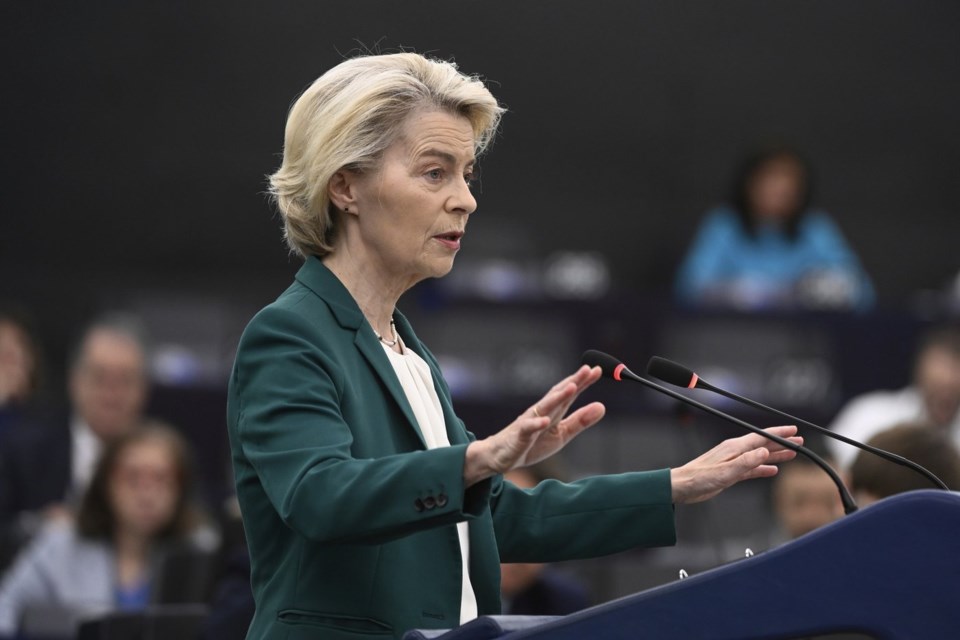

European Commission President Ursula von der Leyen presented the 22nd package of sanctions against Russia on Monday, November 23.
“The aim is to maintain pressure on Russia to end its war of aggression against Ukraine. And we will continue to propose new sanctions until Russia demonstrates a genuine commitment to lasting peace in Ukraine,” von der Leyen said in a statement published on X.
She explained that the package would increase pressure in three areas: targeting the sources of funding for Russia’s war, further isolating the country, and restricting its participation in European sporting and cultural events.
“First, on financial services. We are extending the transaction ban to around 60 Russian banks. All 60 banks will be excluded from the SWIFT system. In addition, we are taking strong measures against cryptocurrency and payment networks. We will focus on Russia, but we will also include third countries that help Russia circumvent our sanctions,” von der Leyen explained, adding that this was one of the main priorities of the new package.
A dedicated cryptocurrency sanctions task force has also been established to support these efforts.
“My second point concerns Russia’s energy sector. We are expanding the ban on energy-related services so that no European company can assist Russia in building, operating or repairing its energy infrastructure, including oil refineries. For the first time, this ban will also cover electricity supply services,” the European Commission President said.
More than 70 additional vessels belonging to Russia’s “shadow fleet” have been added to the sanctions list. A proposal has also been put forward to ban all tankers insured in Russia.
Other initiatives include a visa ban on former Russian combatants.
“Recently, we have witnessed an escalation of unconventional, kinetic activities by Russian agents in Europe. And this ban is part of our response. Former Russian combatants pose a threat to European security. They must not be allowed to move freely across our countries. Therefore, they will be banned from entering the European Union,” von der Leyen stressed.
The package also proposes banning Europeans from continuing to hold positions on the governing bodies of companies in Russia.
“Finally, on sport and culture. Sporting events must not become platforms for propaganda. From today, we are introducing a ban on Russian teams and athletes competing under the Russian flag at all sporting events in the European Union. We are proposing a ban on the display of official Russian symbols,” von der Leyen stated.
In addition, financial flows from Russian sponsors to European-based sporting and cultural associations will be restricted, while limitations will be introduced on Russian nationals holding positions on the governing bodies of European sports federations.
“Our position is clear. We are giving Ukraine strength. The strength to secure peace, while giving Russia every reason to choose it,” von der Leyen concluded.