

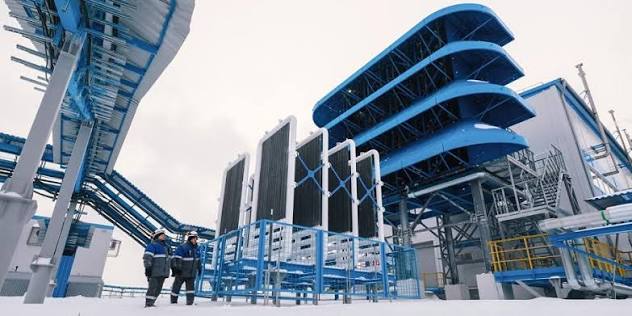

Shares of Gazprom on the Moscow Exchange fell on Friday to their lowest level since January 2009 — 105 rubles per share, according to exchange data.
Over the day, Russia’s largest gas company lost 1.43% in value; since the beginning of the month, it is down 9%, and since the beginning of the year it has fallen 16%. Compared to its pre-war peak in October 2021, it has lost nearly 75% of its value — about 7.5 trillion rubles. According to the Moscow Exchange, Gazprom is now valued at 2.5 trillion rubles, or $34 billion, which is 29 times less than the $1 trillion market capitalization its CEO Alexei Miller once promised in 2008, reports The Moscow Times.
Holding the world’s largest proven natural gas reserves, Gazprom became a victim of its failed attempt to “freeze Europe” and redirect Russian energy flows toward the East. Exports to non-CIS countries have dropped from about 200 billion cubic meters per year before the war to roughly 80 billion cubic meters — a level last seen in the USSR in the mid-1980s. Supplies to the European market, once Gazprom’s largest, have fallen to a 50-year low of around 18 billion cubic meters.
“Gazprom’s revenue from foreign markets is predictably declining despite growing supplies to China,” analysts at Vector Capital note: Beijing buys five times less than the EU did in the late 2010s, and at prices 40% lower.
In Europe, Gazprom risks losing one of its last major customers — Hungary, where the pro-Kremlin Viktor Orbán lost the parliamentary elections.
“There is a high probability that Hungary will abandon Russian gas. […] And currently Hungary is one of Gazprom’s most profitable markets, receiving 8–10 billion cubic meters of gas per year,” says Finam analyst Sergey Kaufman.
In the medium term, the EU is firmly committed to phasing out Russian gas no later than early 2028, and possibly by the fourth quarter of 2027, notes BCS analyst Kirill Bakhtin. “In this context, news about the start of construction of the ‘Power of Siberia-2’ pipeline would be very useful for Gazprom.”
However, the pipeline project with a capacity of 50 billion cubic meters per year is still stalled, and a gas contract with China has not been signed, despite nearly 10 years of negotiations and numerous visits by Vladimir Putin to Beijing.