


By Max Gardus
The fuel crisis in Russia has long gone beyond queues at petrol stations. According to Kpler, in June Russian refineries processed about 560,000 tons of crude oil per day — the lowest level for this period in recent years. Gasoline output at the end of the month was around 90,000 tons per day, 25% less than a year earlier, while summer daily consumption exceeds 110,000 tons. This creates a baseline gap of at least 20,000 tons per day, or about 600,000 tons per month.
In June, rail shipments of oil and petroleum products on the Russian Railways (RZD) network fell by about 17% year-on-year to 13.5 million tons. Exchange sales of AI-92 and diesel on the St. Petersburg International Mercantile Exchange dropped by more than half, while AI-95 fell by about a third, and delivery delays of one to two months have become the norm. At independent petrol stations, prices have already reached 120–140 rubles per liter.
New strikes continue to shift this balance. The Lukoil-Nizhny Novgorodnefteorgsintez refinery in Kstovo — the fourth largest in Russia and the second largest gasoline producer — accounts for about 11% of Russian gasoline production, much of which is supplied to the Moscow region. Damage to the AVT-6 primary distillation unit means not just a loss of crude processing capacity: without its fractions, downstream catalytic cracking, reforming, and hydrotreating units are also deprived of feedstock.
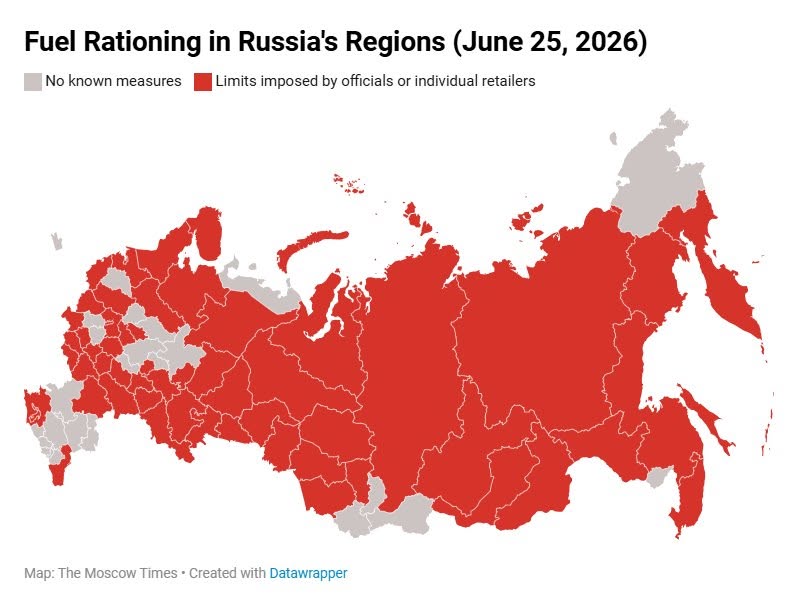
The geography of the shortage is also telling. Both capitals, Moscow and St. Petersburg, receive priority supplies from large vertically integrated oil companies, while in Krasnodar Krai, Irkutsk region, Zabaykalsky Krai, the Volga region, and occupied territories, petrol stations are closing and rationing and manual distribution are being introduced. Deputy Prime Minister Alexander Novak is now speaking not only about overall balance but also about “targeted solutions” for the most vulnerable regions, especially those without their own vertically integrated networks. This means the crisis has become simultaneously production-based, logistical, and regional.
The Kremlin’s first reserve is to increase output by lowering quality standards. The government has allowed the sale of gasoline meeting “Euro-3” standards until the end of the year, effectively returning to a standard banned on July 1, 2016. Tax changes also allow straight-run gasoline to be blended with lower-quality components. Technologically, this allows partial bypassing of damaged deep-processing units and faster production of marketable fuel.
But the cost of this solution is higher sulfur and benzene content, reduced efficiency of catalysts and oxygen sensors. Old carbureted Lada cars may tolerate this fuel more easily than modern Chinese Geely, Haval, Chery, or even Russia’s Lada Vesta. The Russian authorities are effectively shifting part of the crisis cost from refineries and the budget onto car owners, the healthcare system, and urban air quality.
The second tool is imports. Moscow plans to purchase up to 400,000 tons of gasoline per month. Belarus has already nearly tripled rail deliveries to more than 70,000 tons in the first half of June.
Russia tried to buy about 50,000 tons of AI-92 from Kazakhstan, but Astana is demanding an official request and confirmation of available export capacity.
India has already shipped at least 60,000 tons via two tankers. One of the supply chains is linked to the Nayara Energy refinery in Vadinar, 49% owned by Rosneft. The result is an absurd loop: Russia sells crude oil to India, an Indian refinery processes it, and Moscow buys back more expensive gasoline that now includes added value from refining, trading, freight, insurance, and transshipment.
However, 400,000 tons is only about 13,000 tons per day — not enough to cover the current deficit.
Moreover, Russia spent decades building ports such as Primorsk, Ust-Luga, and Novorossiysk for exports, not for large-scale imports of petroleum products.
Imported gasoline requires free storage tanks, laboratory control, transshipment capacity, rail tank cars, and delivery across thousands of kilometers inland. Limited import infrastructure and high final costs will be major constraints on large maritime supplies.
There is also a security risk: both Black Sea and Baltic ports are within the strike range of Ukrainian forces, making import chains potentially unstable.
The third issue is who will pay. The state is already preparing subsidies tied to Indian prices and delivery costs. If imported fuel is at least $100 per ton more expensive than domestic supply, compensation for 400,000 tons would cost the budget about $40 million per month; at a $200 difference — about $80 million.
The alternative is to allow prices to float. In that case, imports become commercially viable, and demand falls. But higher fuel prices would quickly spill over into freight tariffs, agricultural costs, construction, and food inflation. The current third model — administratively suppressing prices in vertically integrated oil company networks — has already created two realities: cheap gasoline that is unavailable, and expensive gasoline sold by independent operators.
The fourth path is regional redistribution. A reduction in mandatory exchange sales from 15% to 10% effectively keeps more fuel within vertically integrated oil companies and their retail networks (about 60% of stations). But 40% of Russian petrol stations are independent, mostly located in small settlements where large chains do not operate. This means resources are being redirected from the regions toward large cities.
How can this be countered?
Through imports. There is also an external way to complicate Russia’s adaptation. The threat of targeted sanctions against traders, banks, shipowners, and terminals involved in supplying fuel to Russia could change the behavior of “neutral” states, many of which are now being offered deals to assist Russia.
Kyrgyzstan, which receives over 90% of its gasoline from Russia, is already seeking assistance from Kazakhstan, Azerbaijan, Uzbekistan, and Turkmenistan. In a regional shortage, the same ton of fuel can either go to Russia or stabilize Central Asian markets. If Russian contracts carry sanctions risk, Baku or Astana may choose safer buyers.
Kazakhstan provides an illustrative example: initial reports suggested talks with Russia for about 50,000 tons, but later Astana demanded an official request and proof of available export capacity. This leaves room for diversion of supply elsewhere.
On refinery repairs: the EU already bans the supply of goods and technologies suitable for oil refining to Russia. The UK has also separately targeted refining equipment, energy technologies, fuel additives, and related services.
The problem is not the absence of sanctions framework, but the need to continuously update lists of critical equipment, track supply chains through third countries, identify specific plants and service companies, and close gaps in spare parts, software, and maintenance.
Russia is unlikely to run out of gasoline entirely.
But each new way of securing supply becomes more expensive than the previous one: first reserves and export bans, then lower-quality fuel, then subsidized imports, and finally manual regional allocation and rationing.
So the real question is no longer whether Moscow will find gasoline, but how much it will pay for each ton — in budget costs, inflation, export revenues, vehicle wear, and regional stability.