

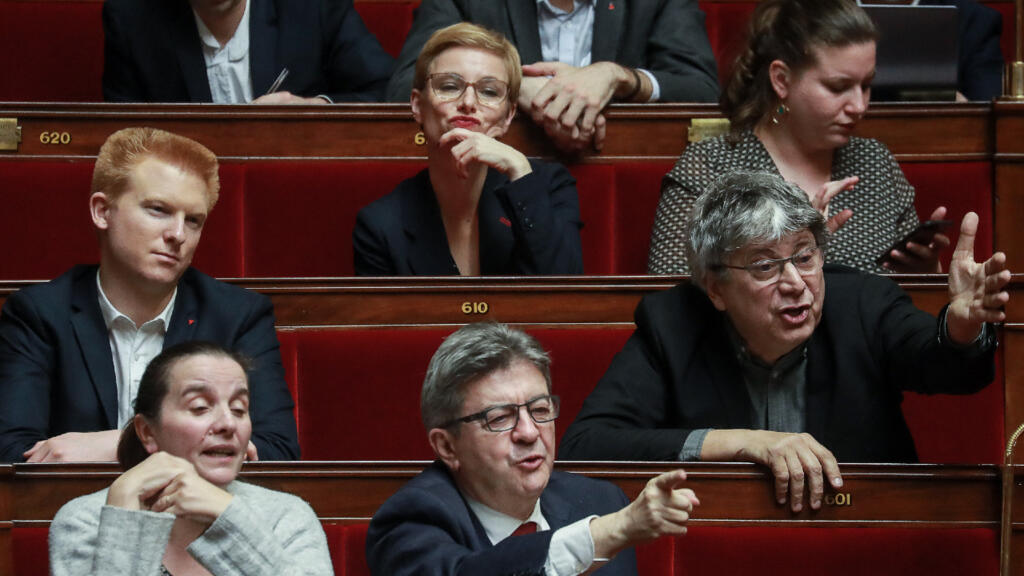

Main image: Members of La France Insoumise — Clémentine Autain, Mathilde Panot, Adrien Quatennens, Éric Coquerel, Caroline Fiat, and Jean-Luc Mélenchon (top to bottom, left to right) — at the French National Assembly on February 25, 2020. © Ludovic Marin / AFP
Russian intelligence services are actively exploiting public statements by members of the French opposition to weaken public and political support for Ukraine across Europe. According to the Robert Lansing Institute (RLI), the Kremlin skillfully incorporates the rhetoric of local populist politicians into its broader influence campaigns.
Analysts highlighted the recent remarks by Jean-Luc Mélenchon, founder and leader of the left-wing populist party La France Insoumise (France Unbowed), who outlined a series of controversial foreign policy proposals. Mélenchon called on France to immediately withdraw from NATO, reject participation in military alliances such as AUKUS, leave key international organizations including the G7 and G20, and begin direct bilateral negotiations with Russia to establish what he described as mutual security guarantees.
He also sharply criticized the European Union and Brussels, accusing them of being incapable of resolving the war, and pledged to implement these policies if elected president in 2027.
According to the Robert Lansing Institute, the Kremlin's propaganda apparatus and numerous pro-Russian media outlets across Europe quickly amplified Mélenchon's statements. Moscow is using his remarks to reinforce longstanding narratives portraying the European Union as deeply divided and Ukraine as having no alternative but to negotiate with Russia on the Kremlin's terms.
Experts argue that Mélenchon's proposals would effectively amount to the voluntary strategic weakening of the EU's second-largest economy and its only nuclear power. At a time of Europe's most serious security crisis since World War II, such measures would not bring peace but instead create a dangerous security vacuum that Russia could exploit for geopolitical gain.
The report also notes that calls for direct negotiations with Moscow ignore the fact that Russia has repeatedly violated major international agreements over the past 12 years, including the UN Charter, the Helsinki Final Act, and the Budapest Memorandum. Negotiating with the Kremlin before the deoccupation of Ukrainian territory and without holding Russia accountable would effectively legitimize the use of force in international relations.
By blaming Brussels for the war, Mélenchon shifts responsibility away from Russia—the aggressor—and onto Ukraine and its Western allies, while overlooking that the duration of the conflict is determined by Russia's unprovoked invasion and its continued refusal to withdraw its forces.
From an intelligence perspective, RLI says Mélenchon should not be viewed as a controlled agent or conscious asset of Moscow, but rather as a highly effective independent amplifier of Russian narratives—a phenomenon Russian information doctrine describes as "reflexive exploitation" or "useful activity."
The institute notes that there is no publicly available evidence of direct financial or operational ties between Mélenchon and the Kremlin. However, his longstanding anti-American and anti-globalist rhetoric closely aligns with Russia's strategic objectives.
Russian state media outlets—including RT, Sputnik, RIA Novosti, and TASS—have developed a consistent method of information laundering: they extract controversial statements by the French politician, strip away their domestic political context, and redistribute them through networks of proxy websites, bots, and Telegram channels as supposed evidence that the Western coalition is weakening and inevitably falling apart.
This enables Moscow to rely not on its own propaganda but on the words of a prominent European politician, increasing the credibility of its disinformation among European audiences.
Analysts also point out that the positions of France's radical left on security issues are increasingly converging with those of the far right, including Marine Le Pen's National Rally, which has also advocated reducing France's role in NATO's military structures. This convergence between left- and right-wing populist movements creates fertile ground for Russian hybrid influence operations.
Historically, Mélenchon has combined three longstanding traditions in French politics: left-wing anti-imperialism, Gaullist independence from Washington, and Cold War-era neutrality. According to the report, this approach resembles that of figures such as Jean-Pierre Chevènement and the former French Communist Party, whose anti-NATO positions were actively supported by the KGB during the Cold War.
Ahead of France's 2027 presidential election, RLI assesses that Russian intelligence services are likely to focus less on securing the victory of any particular candidate than on deepening political polarization and fragmenting the French political landscape.
The Kremlin understands that La France Insoumise, with its left-wing, anti-capitalist, and environmental platform, is ideologically incompatible with today's conservative-nationalist Russia and is unlikely to become a reliable long-term partner. Instead, Moscow views the movement as a useful tactical instrument for weakening Western unity.
According to the institute, the greatest information threat posed by Mélenchon's statements lies in their potential to gradually normalize public skepticism toward NATO and sanctions. His foreign policy platform could significantly reshape France's 2027 election debate by forcing mainstream centrist and conservative candidates to spend political capital defending the principles of transatlantic solidarity—an outcome that aligns closely with Moscow's long-term objective of undermining European unity.