

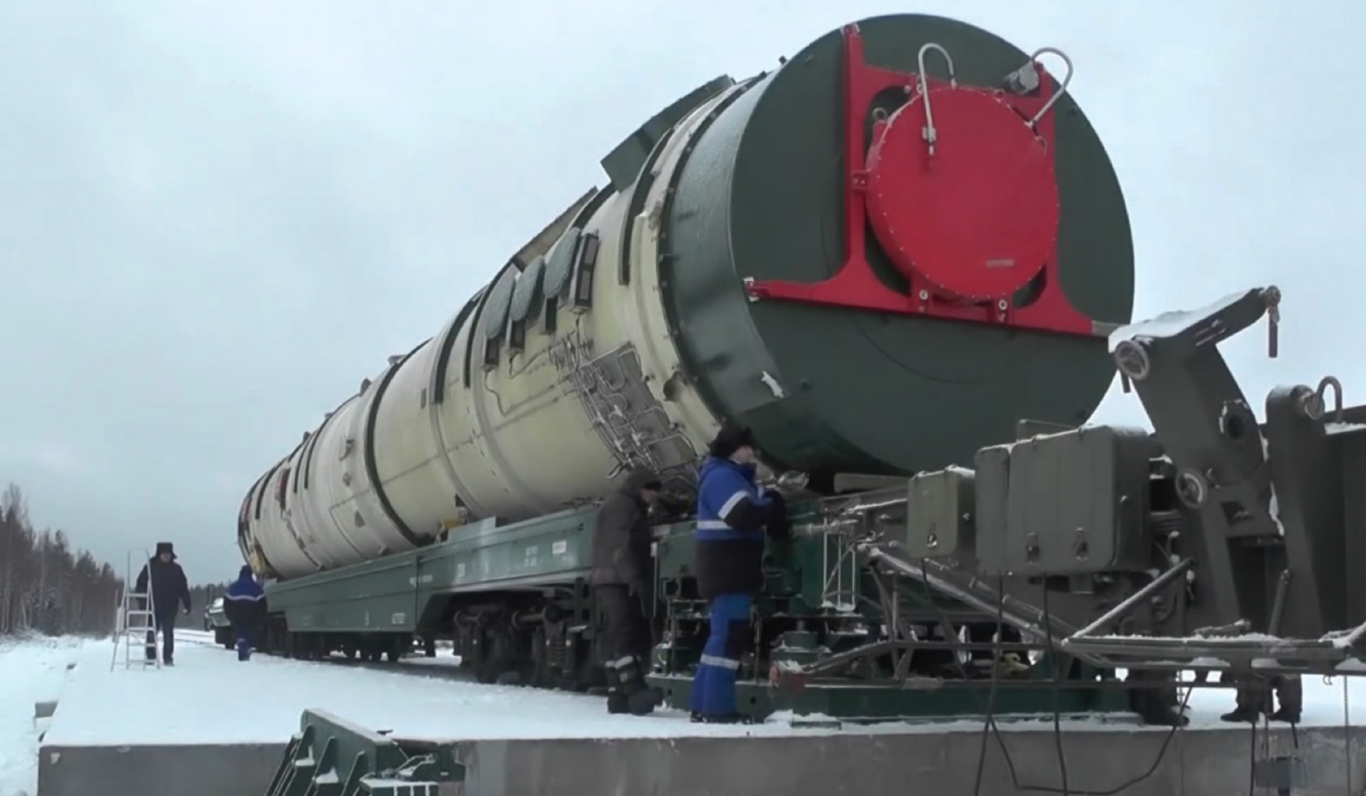

The UK's Royal United Services Institute (RUSI) has published an extensive study examining how Russia's nuclear arsenal could evolve in the coming years and which weapons systems Moscow is likely to prioritise for investment.
The report's author, Sidharth Kaushal, analysed Russian military publications, the country's nuclear doctrine and the capabilities of its defence industry.
Key findings:
- Russia is likely to focus less on expanding the number of nuclear missiles and more on improving their ability to penetrate US missile defences and conduct strikes in the early stages of a conflict.
- Russian military leaders regard the possibility of a US disarming strike as their principal threat. In such a scenario, precision-guided conventional and nuclear weapons could destroy a substantial proportion of Russia's strategic forces before they could be deployed.
- One Russian military publication examines a scenario in which an initial conventional strike could disable approximately 65% of Russia's nuclear capabilities.
- Moscow's concern is that even a limited non-nuclear strike could significantly weaken its ability to launch a nuclear retaliatory attack, particularly given the continued development of US missile defence systems.
- As a result, Russian strategy is increasingly focused on the possibility of launching missiles before an enemy attack has concluded and, in certain scenarios, conducting pre-emptive strikes. Mobile Yars missile systems and nuclear-powered ballistic missile submarines are expected to preserve part of the arsenal for subsequent retaliation.
- Continued advances in satellite reconnaissance and precision-guided weapons are making mobile missile launchers increasingly vulnerable. Russia is therefore likely to concentrate on improving the survivability of existing systems and disrupting enemy intelligence capabilities.
- Against this background, particular importance is attached to the heavy silo-based RS-28 Sarmat intercontinental ballistic missile, designed to replace the Soviet-era R-36M. According to RUSI, the new missile could carry up to 10–15 independently targetable nuclear warheads, allowing a single launcher to strike multiple targets.
- Its design also aims to shorten the boost phase of flight, when the rocket engines are operating and the missile is relatively vulnerable to detection and interception. However, the Sarmat programme has encountered serious technical difficulties, while its high cost limits the prospects for mass production.
- Another particularly interesting area concerns efforts to counter US satellites used for reconnaissance, missile launch detection and weapons guidance. The report mentions Russia's Peresvet and Kalina laser systems, as well as the airborne Sokol-Eshelon system, all designed to interfere with satellites' optical equipment.
- However, as large satellite constellations are deployed, the effectiveness of such systems becomes extremely limited. Instead of targeting a handful of large satellites, they must contend with hundreds of smaller spacecraft.
- As an alternative, Russian specialists are considering orbital electronic warfare systems and even space-based nuclear weapons. According to the author, a nuclear explosion at high altitude could theoretically disrupt the operation of a large number of satellites simultaneously, at least temporarily.
- In the European theatre, RUSI expects increased attention to intermediate-range missiles, particularly the Oreshnik, which Kaushal links to the revival of the Soviet-Russian RS-26 Rubezh programme. Such missiles are viewed as a means of rapidly striking important NATO military facilities, including airfields, weapons depots and missile system positions.
- Their advantages include relatively short flight times and the difficulty of interception. However, Russian production capacity remains severely constrained. For comparison, even the Soviet Union, with its considerably more powerful industrial base, produced only around 40 comparable RSD-10 Pioneer missiles annually.
- Consequently, the author expects Russia to maintain a relatively small Oreshnik arsenal in the near term. He considers its most likely role to be nuclear, despite Russia having already demonstrated an attempt to use the missile with a conventional payload.
- No substantial numerical expansion is expected in the naval or aviation components of Russia's nuclear forces either. Project 955 Borei submarines equipped with Bulava missiles will continue replacing older Soviet-era ballistic missile submarines, while Project 885 Yasen nuclear-powered multipurpose submarines could be used to threaten missile strikes close to the US coastline.
- Russia's strategic aviation, meanwhile, remains dependent on its rapidly ageing Tu-95MS and Tu-160 bombers, while the prospects for developing the new PAK DA bomber remain uncertain. The new Kh-BD cruise missile, with a claimed range of approximately 6,500 kilometres, is intended to compensate for this limitation to some extent by enabling strikes without aircraft having to approach US territory.
- Overall, Kaushal concludes that Russia's nuclear arsenal will gradually return to a model in which heavy silo-based missiles and rapid-strike capabilities play the dominant role.
- Despite the expiry of the New START treaty in February 2026, a sharp increase in the number of delivery systems appears unlikely because of production costs, a shortage of qualified specialists in Russia, and the simultaneous need to rebuild conventional military forces following the war against Ukraine.
- Rather than embarking on a large-scale arms race, RUSI forecasts that Moscow will concentrate on modernising existing systems, improving their effectiveness and developing capabilities to disrupt Western intelligence and missile defence systems during the early stages of a potential conflict.