

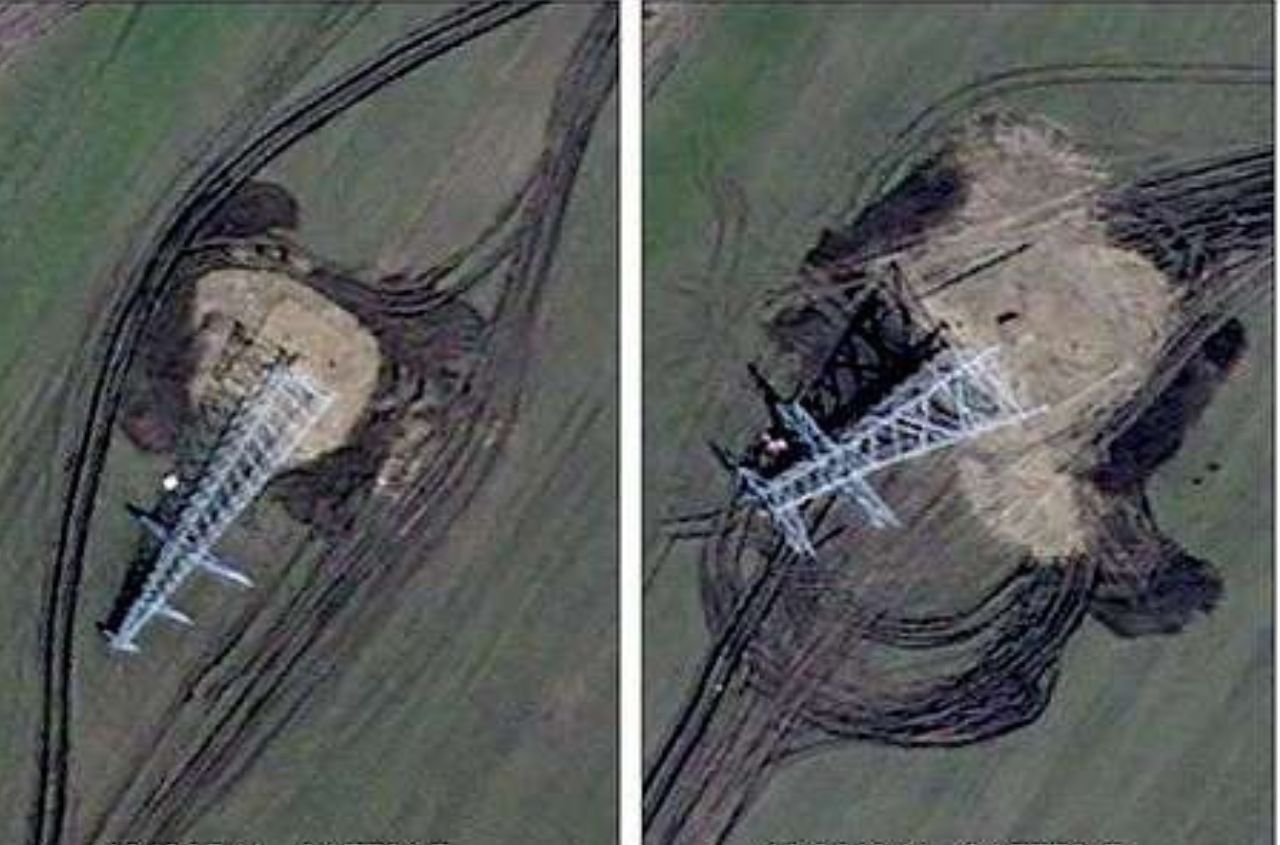

New satellite imagery has revealed another Russian attempt to connect the Russian-occupied Zaporizhzhia Nuclear Power Plant (ZNPP) to the power grid of occupied Ukrainian territories and Russia's energy system, a project that was disrupted by Ukrainian drone strikes, according to Greenpeace Ukraine.
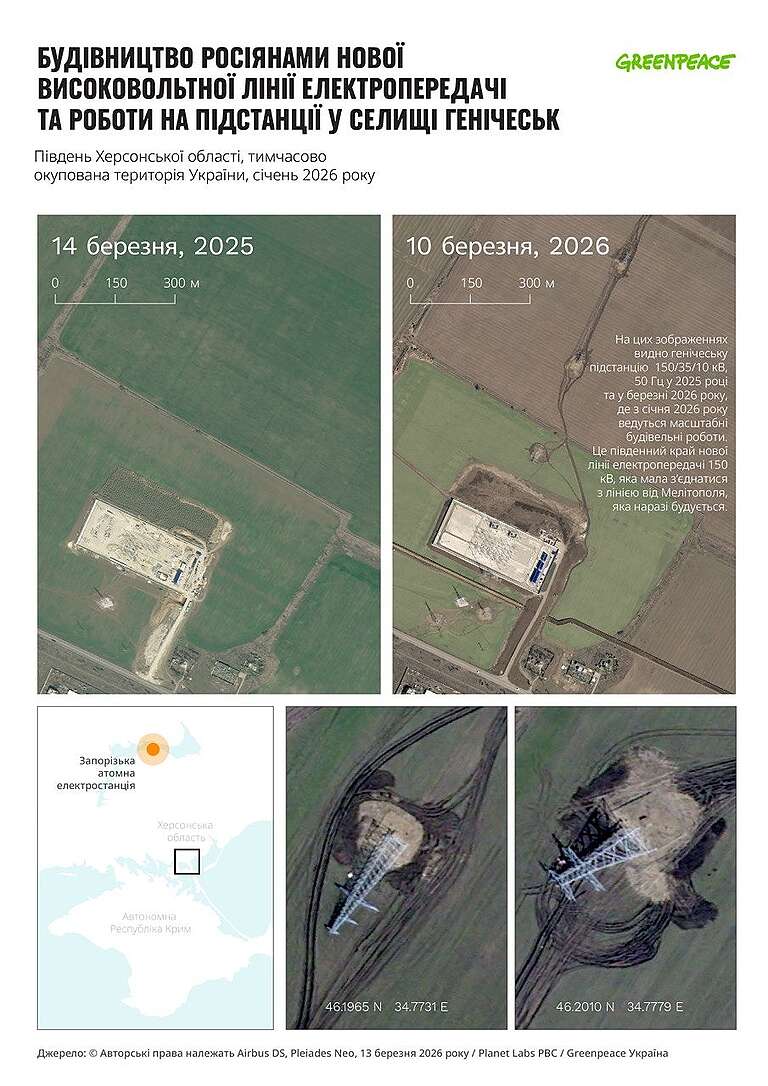
The environmental organization said Russia is constructing a new high-voltage power line along the M18 highway, known as the "Road of Death," linking occupied Mariupol with Henichesk. The infrastructure is described as a key element of Moscow's plan to connect the occupied nuclear plant to the electricity network of occupied territories, including Crimea, and eventually to Russia's national grid.
"This project demonstrates the Kremlin's intention to permanently integrate the captured power plant into Russia's energy system," Greenpeace Ukraine said, adding that its analysis indicates the project is increasingly likely to fail and should be stopped to reduce nuclear safety risks.
The findings are based on high-resolution satellite images collected between January and July 2026. According to Greenpeace, construction of the transmission line between occupied Melitopol and Henichesk was nearly complete by May but was repeatedly disrupted by Ukrainian drone strikes, including an attack on a substation in Henichesk in early July.
Greenpeace Ukraine said the new transmission line is intended not only to support Russian military logistics and extractive industries in occupied southern Ukraine but also to serve as a critical component of Moscow's long-term strategy to export electricity from the occupied Zaporizhzhia plant to occupied territories, including Crimea, and southern Russia.
The report also criticizes International Atomic Energy Agency (IAEA) Director General Rafael Grossi, claiming his public remarks about the possibility of restarting the plant's reactors under Rosatom's management reinforce Russian narratives. Greenpeace argues that Grossi has failed to emphasize that Russia's occupation of the facility itself constitutes a fundamental violation of international nuclear safety and security principles.
Jan Vande Putte, a nuclear energy expert at Greenpeace Ukraine, said Russia has used its occupation of the Zaporizhzhia plant as an instrument of "nuclear terror" against Europe since 2022.
"The new transmission line from Melitopol will not change the overall trend, which increasingly indicates that Russia's occupation project at the Zaporizhzhia Nuclear Power Plant is doomed," Vande Putte said. He called on the international community, including the IAEA, to accelerate efforts to end Russia's occupation of the facility, including through tougher sanctions.
According to Greenpeace Ukraine, Russia's strategic objectives for the plant include disconnecting it from Ukraine's power grid, restarting its reactors, supplying electricity to industry in occupied Donbas, supporting mining and agriculture in occupied territories, powering military logistics, and exporting electricity to southern Russia.
The organization stressed that the Melitopol-Henichesk transmission line is only one element of a broader Russian strategy aimed at maintaining long-term control over the Zaporizhzhia plant and supplying electricity to occupied parts of Zaporizhzhia, Kherson, Donbas, Crimea, and eventually Russia's southern regions.
Greenpeace also said Rosatom views the occupied plant as a cheaper alternative to constructing new nuclear reactors in Russia's Rostov and Krasnodar regions. Although Moscow's plans are becoming increasingly unrealistic, the organization warned that the nuclear safety risks continue to grow.
According to Greenpeace, any loss of external power or cooling systems—particularly for spent nuclear fuel pools—could result in a large-scale radioactive release, a danger directly linked to Russia's occupation of the facility and its war against Ukraine.
Greenpeace Ukraine has monitored Russian plans for the Zaporizhzhia plant since 2023. In September 2025, the organization reported that Russian proposals for jointly using electricity generated by the plant suggested Moscow's ability to implement its plans was already weakening.
The organization also accused Russia of attempting to persuade IAEA Director General Rafael Grossi to promote narratives portraying the long-term Russian occupation of the plant and the restart of its reactors under Rosatom as inevitable.
Sean Burnie, a senior nuclear specialist at Greenpeace Ukraine, said Grossi continues to undermine international efforts to end Russia's illegal occupation of the facility.
"Russia's plans to restart the reactors and integrate the plant into its power grid are illegal under international law and are becoming increasingly unrealistic. That is the message the IAEA should be delivering to Rosatom and the Russian government," Burnie said.