

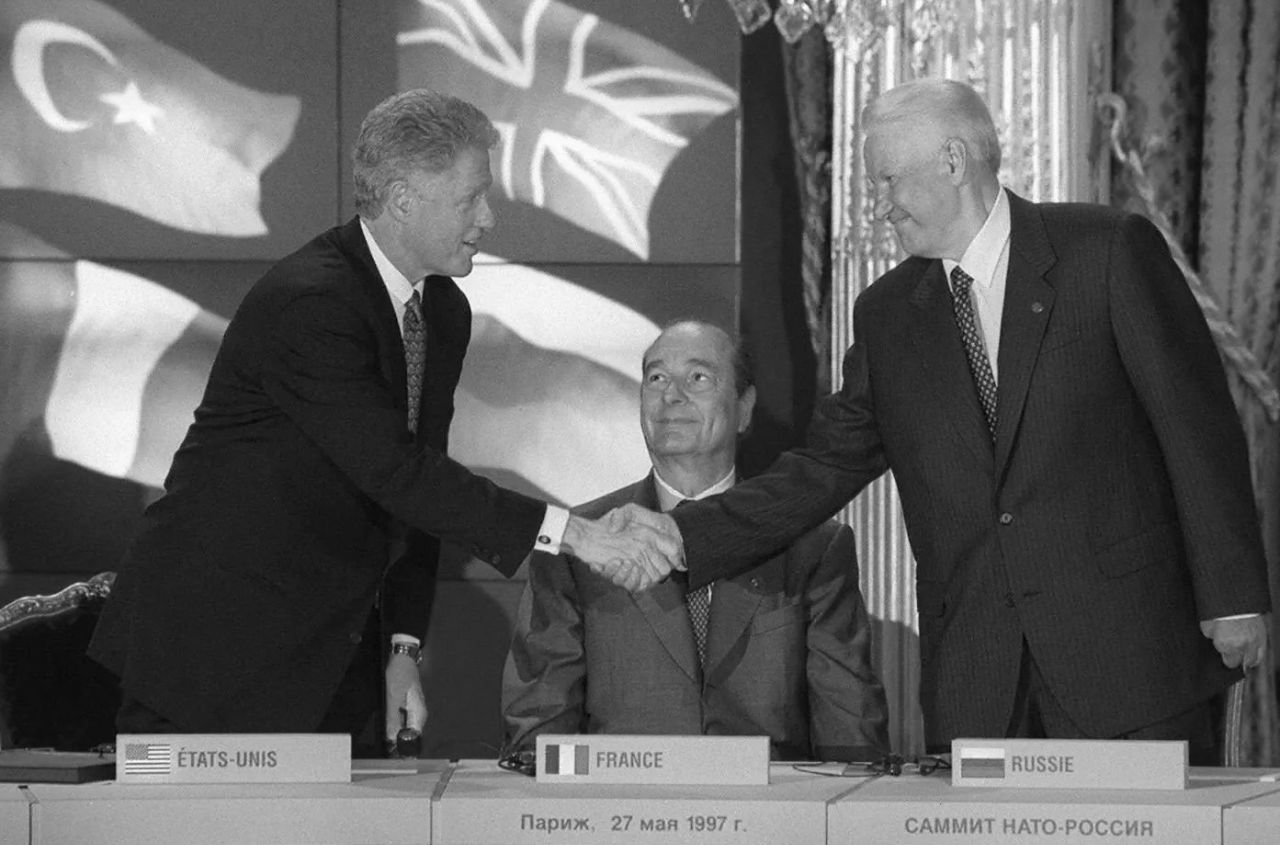

And one more thing about the “European security architecture” that Russia is now proposing. The thing is, it already existed. It really did. And it even worked.
On 27 May 1997, in Paris, Russia and NATO signed the Founding Act on Mutual Relations, Cooperation and Security, at the Élysée Palace in Paris, France. Let me repeat that: Russia signed it.
And what do we find in this document? The parties declared that they no longer regarded each other as adversaries and would build their relationship on cooperation, respect for state sovereignty, and the renunciation of the threat or use of force. Excellent. We'll take that.
But it gets even more interesting. If you read the document, you'll find that it contains no prohibition on admitting new member states. Moscow has no veto over anyone joining NATO.
Moving on.
NATO stated that, in the security environment of the time and the foreseeable future, it would carry out collective defence primarily through interoperability, integration and reinforcement capabilities, rather than through the additional permanent stationing of substantial combat forces.
Pay attention to the phrase “in the current and foreseeable security environment”.
In other words, as long as things remained stable, there would be no substantial additional permanent NATO combat forces stationed in countries bordering Russia.
And what about Russia? Well, here's what.
Section I includes the following commitment:
“refraining from the threat or use of force against each other as well as against any other state, its sovereignty, territorial integrity or political independence in any manner inconsistent with the United Nations Charter”.
ANY OTHER STATE. Including, of course, Ukraine.
And here's the icing on the cake: respect for the sovereignty, independence and territorial integrity of all states, and for their right to choose the means of ensuring their own security.
Did you catch that? “Their right to choose the means of ensuring their own security.”
In other words, Moscow's demand that Kyiv remain outside military alliances directly contradicts this principle.
So, what can we conclude from all this?
The architecture existed. But in 2014, one of its participants took a spectacular dump on these provisions, the UN Charter, international law and all those other inconvenient niceties, demolished the entire structure and opened a portal to hell.
“Wherever a Russian soldier sets foot, that land is ours.”
Or, for that matter, wherever a Russian soldier's foot ends up lying.
The “current and foreseeable security environment” has, shall we say, changed somewhat.
Then again, the Budapest Memorandum has already given us a pretty good idea of just how flexible Putin's interpretation of international agreements can be.