


The Russian Federation is increasingly using Cossack associations in Europe and beyond as effective tools for intelligence gathering and conducting hybrid influence operations. Moscow is deliberately expanding international Cossack networks through cultural events, youth outreach, and activities coordinated via Russian diplomatic missions. According to a report by the US-based research center The Jamestown Foundation, this provides the Kremlin with potential channels for psychological operations, subversive activity, and broader mobilization in support of Russian interests across Europe.
On the international level, the role of Cossacks in the war against Ukraine and the celebration of Russian military victories are used as a powerful instrument of influence to achieve Moscow’s geopolitical goals. One such example was recorded on June 16 in Hanover, Germany, where the 7th International Cossack bivouac took place, bringing together participants from across Germany and a delegation from the Spanish Association of Volga Cossacks. Ataman Sergey Bodryakov of the All-Great Don Host, in his address to attendees, emphasized that in a “tense political situation, Cossacks living outside their homeland help preserve the spirit of Russian Cossackdom and the memory of victories of the Russian army.” Analysts assess such cultural activity as a convenient cover for groups involved in Russian psychological operations.
A significant rise in Cossack activity has been observed across Europe, according to Andrey Shestakov, ataman of the Finnish Cossack yurt and representative of the Council of European Atamans. He stated that Cossack organizations are now actively developing in almost all European countries, using museums as cultural centers and working with youth to promote patriotic education in loyalty to Russia.
This activity has already caused concern in countries hosting emigrant communities. For example, in Finland, local journalists increasingly consult experts to understand the context and background of these communities.
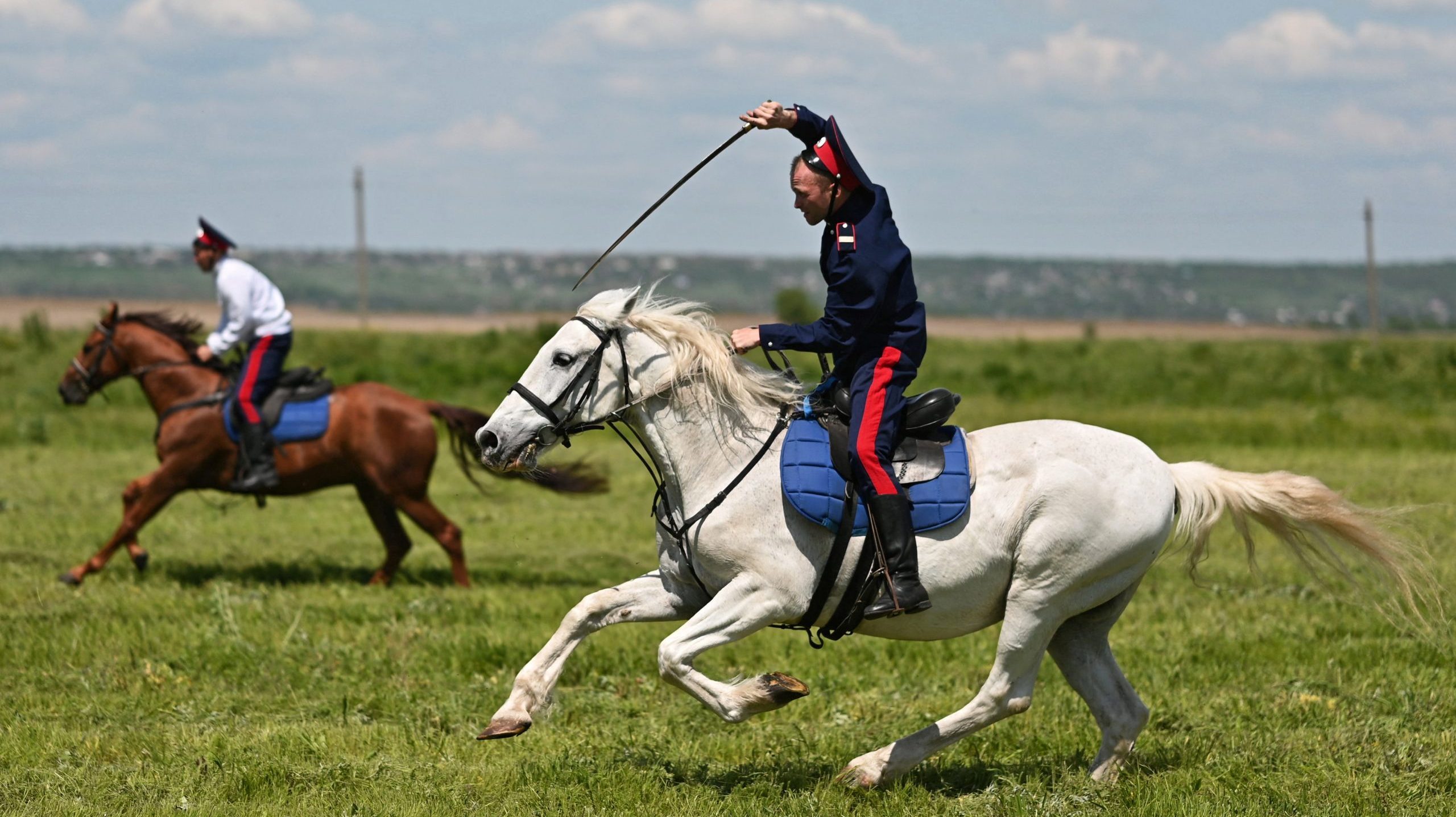
The geography of such influence campaigns spans multiple countries, including Australia, Germany, Spain, and France. In particular, French Cossacks made a symbolic visit to the Russian Embassy in Paris in late 2024. In Madrid, a large meeting was held at the Russian Embassy, where representatives from France, Spain, Germany, Finland, and Russia discussed the historical role of Cossacks, which also fits into the broader framework of Kremlin soft power strategy. At such events, including earlier gatherings in Hanover organized by the “Council of Cossacks of Europe” and the structure SKVRiZ led by Nikolai D’yakonov, participants reportedly not only study traditions but also practice paramilitary skills, including maneuvering, combat medicine, and use of the nagaika whip.
In parallel with its international expansion, Russia is conducting a large-scale revival of non-authentic Cossack organizations within the country, aiming to simplify the militarization of society by appealing to historical emotions. A key indicator of their growing status is the mass inclusion of Cossack formations in May 9 Victory Day parades across the country. Cossack units from the Volga and Orenburg regions reportedly expressed readiness to send 130 participants to the Moscow parade, including university students and veterans of the war against Ukraine.
The expansion of paramilitary structures from newly occupied regions indicates a systematic strengthening of the Cossack movement by the state, which aligns with earlier statements by Nikolai D’yakonov about exponential growth, according to The Jamestown Foundation. Inside Russia, this process is closely linked with the Russian Orthodox Church. Recent meetings of Metropolitan Timofey Chaikin, head of the synodal committee for Cossack affairs, with youth department leaders focused on creating a strict system of pastoral oversight and introducing academic initiatives such as a new master’s program in Cossack studies.
This entire system is aimed at reinforcing militarized patriotism among youth. Today, Cossack associations represent one of the most significant vectors of Russian hybrid influence globally, and experts do not rule out that these structures could play an important role in the event of a hypothetical kinetic conflict in Europe.