

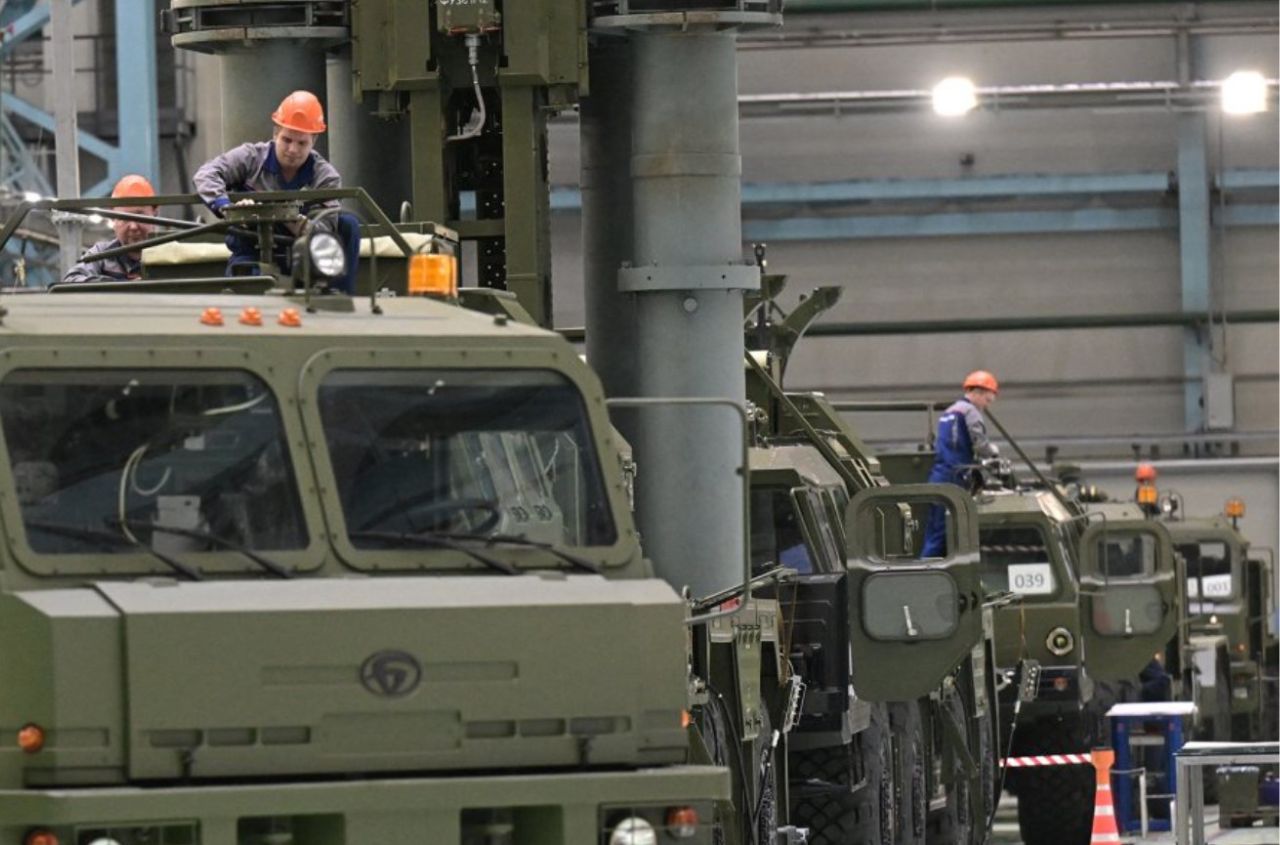

Main image: ILYA PITALEV/SPUTNIK/AFP/Getty Images
A new report for the CSIS | Center for Strategic & International Studies has been released, focusing on the evolution of Russia’s defense industrial complex. The report is based on a detailed analysis of five key Russian defense companies: Uralvagonzavod, Almaz-Antey, KRET, Kalashnikov Concern, and Ushkuynik.
One of the main conclusions is that, despite Ukraine’s successes on the battlefield, underestimating the potential of Russia’s defense industrial complex would be a mistake. The analysis of all five companies shows a significant expansion of production, a high ability of the industry to adapt to wartime conditions, and the rapid implementation of lessons learned on the battlefield. This means Russia is likely to remain a serious military challenge for Ukraine and Europe in the coming years.
Key findings of the study:
• Accelerating consolidation. Wartime conditions have strengthened the concentration of the industry around major state-owned defense holdings, primarily Rostec and Almaz-Antey.
• Continued expansion of production capacity. Satellite imagery and procurement data indicate ongoing construction and modernization of facilities, as well as continued investment in leading defense companies despite sanctions.
• Russia has bet on the “drone revolution.” Both traditional weapons manufacturers and new companies are rapidly increasing drone production and integrating artificial intelligence and electronic warfare technologies.
• Labor shortages have not halted production growth. Companies are addressing workforce challenges through large-scale recruitment, expanded training programs, and the creation of new channels for attracting employees.
• Military production has fully displaced civilian production across a significant part of the defense-industrial sector.
• Sanctions increase costs but have not stopped production. Russian enterprises continue to rely on imported components, using complex schemes to circumvent sanctions.
• The defense industry is shifting toward the production of cheap, mass-produced, and easily scalable systems — primarily drones and electronic warfare equipment — while maintaining a high production pace.
The main conclusion: Russia’s defense industrial complex will maintain a mobilized mode of operation even if the intensity of fighting in Ukraine decreases, and Russia will remain a long-term challenge for Europe.