

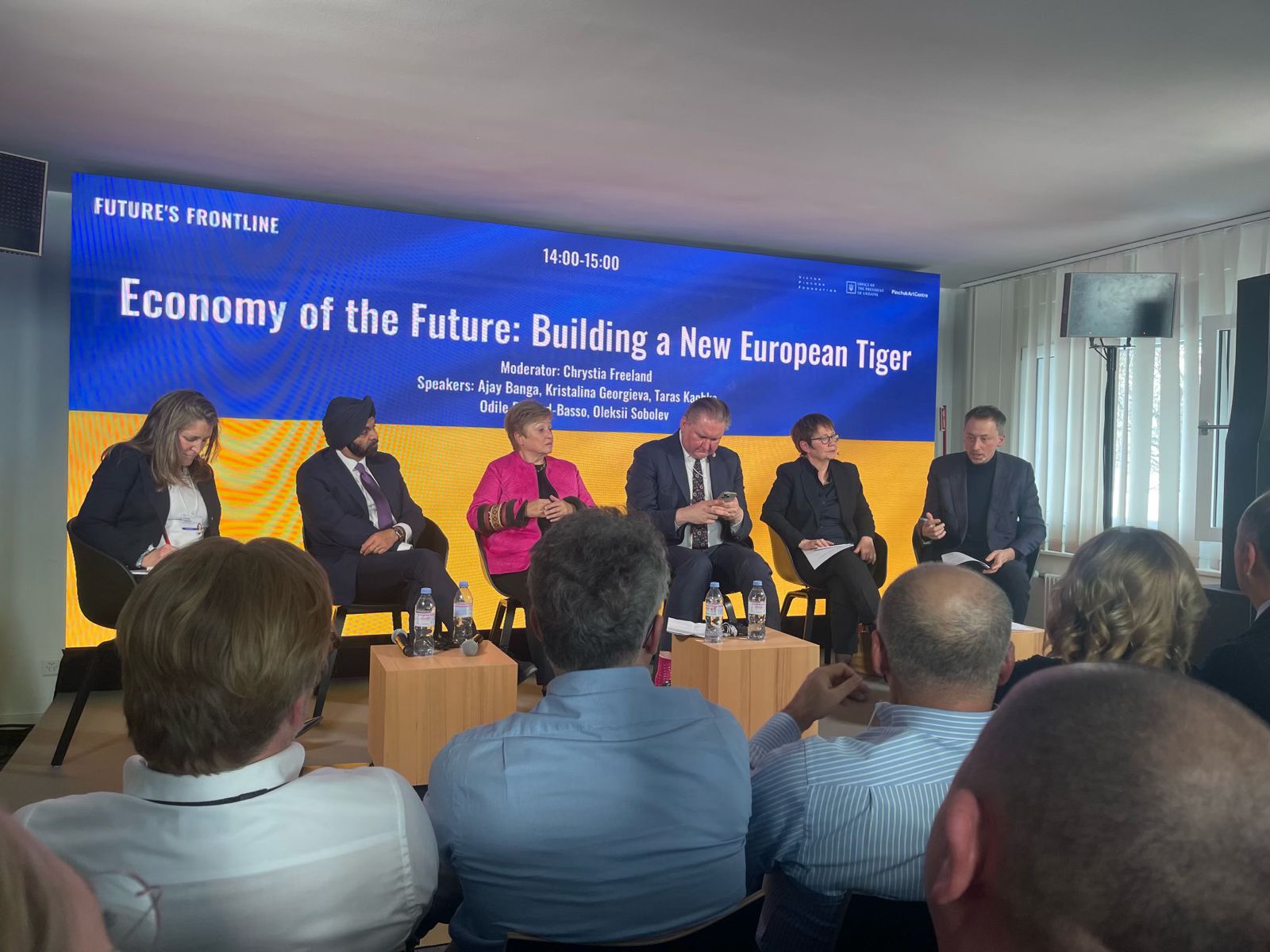

In Davos, as part of the World Economic Forum Annual Meeting 2026, a high-level discussion titled “Economy of the Future: Shaping the New European Tiger” was held, focusing on Ukraine’s economic trajectory after the war and the conditions for attracting investment.
The discussion included the President of the World Bank Group, Managing Director of the International Monetary Fund Kristalina Georgieva, Ukraine’s Vice Prime Minister for European and Euro-Atlantic Integration Taras Kachka, President of the EBRD Odile Renaud-Basso, and Ukraine’s Minister of Economy, Environment and Agriculture Oleksiy Sobolev. The session was moderated by Ukraine’s Presidential Adviser on Economic Development, Chrystia Freeland.
During the discussion, leaders of international financial institutions emphasized that support for Ukraine must combine financing, reforms, and measures that build investor confidence. IMF Managing Director Kristalina Georgieva noted that the IMF has adapted its tools to support Ukraine during wartime and stressed the importance of continuing reforms and anti-corruption measures to maintain trust among partners and the private sector.
World Bank Group President Ajay Banga highlighted that Ukraine’s recovery should include economic modernization, private sector development, and the adoption of technologies, including data-driven and AI-based solutions. He also stressed that a long-term vision for development must be formulated and implemented under Ukraine’s leadership.
A particular focus of the discussion was the Economy of the Future—a financial model that the Ukrainian government has been developing for about a year in collaboration with the World Bank. The model outlines Ukraine’s postwar development trajectory over the next 15 years and identifies the conditions necessary for recovery to transition into sustainable economic growth.
“We need to talk not only about reconstruction but also about rethinking Ukraine’s economy as one based on technology, data, and AI-driven solutions, while relying on natural resources and the private sector. Key prerequisites include governance reforms, the rule of law, and advancing European integration as a practical framework for change. A crucial condition for such a reboot is the privatization of state-owned enterprises and modern models of private management, which create investment opportunities and improve efficiency,” said Ukraine’s Minister of Economy, Environment and Agriculture Oleksiy Sobolev.
“Security is a fundamental condition for economic development, both for Ukraine and for Europe itself, and its cost will only increase if Russia continues its aggressive policies. Prosperity is another pillar for future success, but it is impossible without security. For Ukraine, European integration is a concrete and measurable list of tasks, and we are changing not just on paper, but through real actions even during wartime,” emphasized Ukraine’s Vice Prime Minister for European and Euro-Atlantic Integration Taras Kachka.
The key focus of the discussion was on what needs to be ensured so that Ukraine’s economic recovery is rapid and growth is sustainable and predictable for investors. Participants discussed the necessity of reliable security guarantees as a fundamental condition for major investment initiatives, the scale and priorities for rebuilding destroyed infrastructure, and how attracting new capital should not only serve reconstruction but also increase economic productivity. A separate topic was human capital: the return of people, access to skilled labor, and policies that allow businesses to plan development and invest in jobs.