

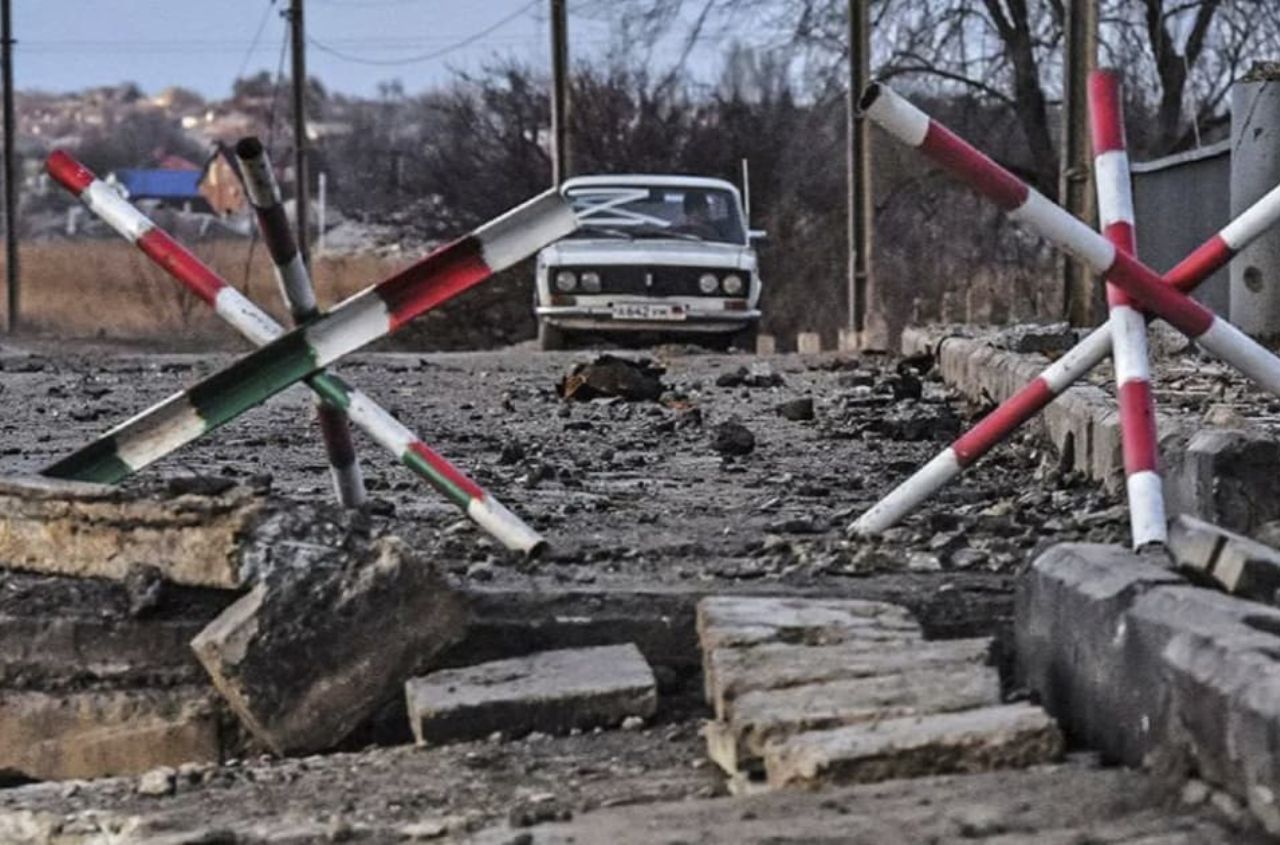

The Russians have not yet organized the evacuation of people from the blocked town of Oleshky in the occupied part of Kherson region; instead, they are intimidating residents with alleged “Ukrainian Armed Forces provocations.” Local residents who are able to do so leave at their own risk and at their own expense, while others still hope for an organized evacuation. This was reported to Ukrinform by Tetiana Hasanenkо, head of the Oleshky City Military Administration.
“Five settlements in the community have been completely destroyed — it is clear that there is pain, but there are currently no living people there. Another three settlements — such as Kozachi Laghery, Pidlisne, and Solontsi — are about 80% destroyed, with a very small number of people still living there. In Oleshky, up to two thousand people remain, and food deliveries are extremely irregular,” Hasanenkо said.
According to her information, the last delivery of food to the city took place last Monday. She stressed that there is no complete picture of what is happening in the city, as local residents are restricted in their movement and can only report what they themselves have seen.
According to the head of the military administration, entrepreneurs who delivered food last week, despite shortages and a difficult humanitarian situation, were unable to sell all of the goods. First, many people do not have money, and to obtain cash they would have to travel to Skadovsk.
“If this could be done easily and without risk to life, those residents would simply leave Oleshky,” she said. Second, suppliers cannot properly store goods in summer conditions without refrigeration — especially meat and sausages. Food spoils quickly, there is no electricity in the city, no fuel for generators, and no way to organize trade in compliance with sanitary standards,” Hasanenkо explained.
She noted that there was an attempt to deliver food on June 2 using four vehicles, but the transport hit mines; one driver was killed and three others were injured.
“So will there be people willing to go again? The situation is cyclical. Someone passes through, then deliveries resume weekly, then vehicles are blown up — and the supply stops. When the next attempt will be, or whether there will be one at all after this incident, is unknown,” she added.
Regarding evacuation, the head of the administration emphasized that the Russians are not carrying out any organized evacuation. What is happening instead is people leaving at their own risk and at their own expense. They are transported either by private carriers or by entrepreneurs who bring in food.
“This requires money, payment is needed. This is in no way a reproach to the carriers, because people who travel to Oleshky are literally risking their lives, not to mention fuel and other expenses,” she noted.
According to her, about 200 people managed to leave Oleshky over three months — from March to May. She does not exclude that the real number may be slightly higher, as some departures may not have been reported.
“At the same time, we should not forget how many attempts to leave — both independently and with carriers — ended tragically, not just with injuries but with deaths. So it is always a risk, and people understand each time that this attempt may be a one-way trip. But they no longer have the strength to stay in those conditions, so they risk their lives,” Hasanenkо said.
She also added that one of the reasons people do not leave is their inability to abandon animals — their own, those that have come to them over the years, or those they were asked to look after.
As for the occupying authorities, Hasanenkо stressed that they have promised local residents that by August food deliveries to the city would allegedly occur twice a week.
“There is no trust in them, of course, because everything is already happening differently. What will happen after August is unknown. Local residents who are still hesitant to leave hope that there will eventually be an organized evacuation. However, the occupiers in their online channels scare people, saying they cannot organize evacuation because they allegedly fear provocations from the Ukrainian Armed Forces. This is how the occupiers respond to our calls to carry out evacuation,” she said.
According to her, the Russians are currently unwilling to evacuate people even to other occupied communities located farther from the front line, let alone facilitate evacuation abroad or to Ukrainian-controlled territory.