

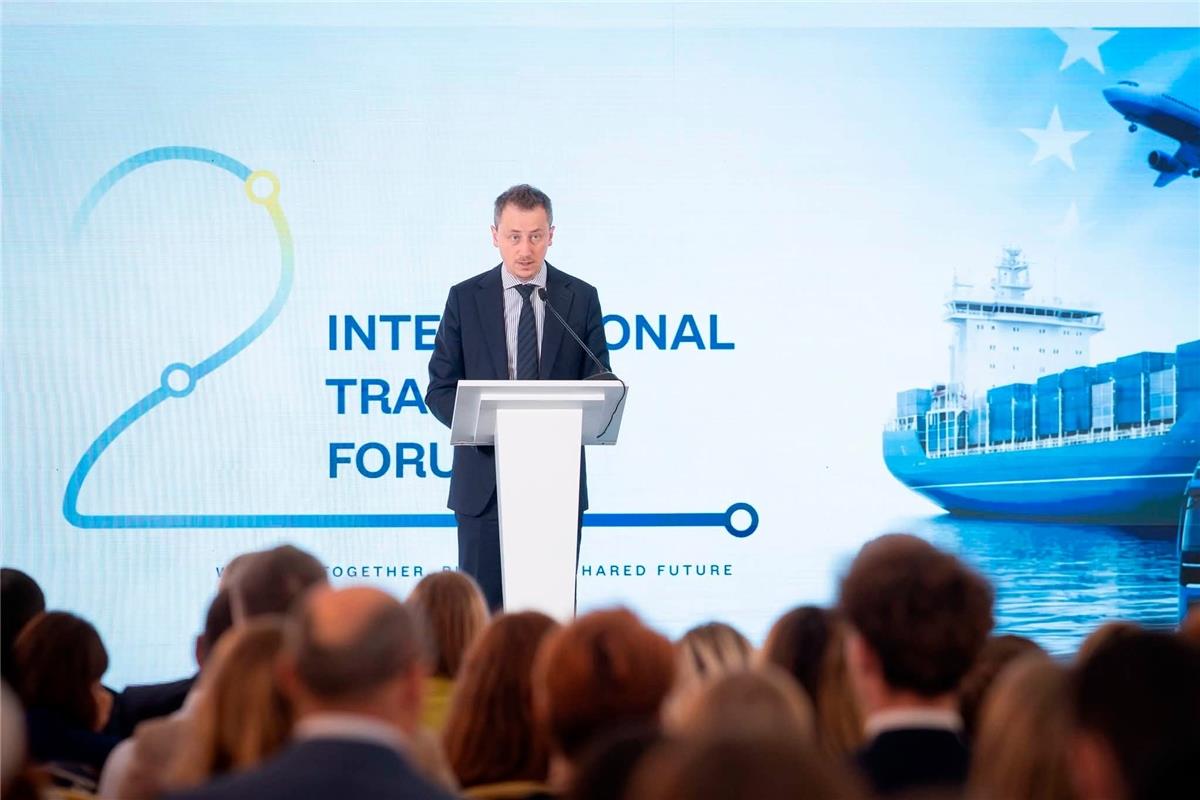

Ukraine’s Export Strategy through 2030 was presented during the Second International Trade Forum. The program aims to increase exports of goods and services to $85 billion, raise their share in GDP to 33%, expand exports of high value-added products, and reduce dependence on a raw-material-based economic model.
The event was attended by Deputy Prime Minister for European and Euro-Atlantic Integration of Ukraine Taras Kachka, Minister of Economy, Environment and Agriculture of Ukraine Oleksii Sobolev, as well as representatives of the EU Delegation to Ukraine, the German Embassy in Ukraine, and major businesses.
“$85 billion in exports by 2030 is an ambitious goal of Ukraine’s new Export Strategy. This strategic document is a roadmap for the development of Ukraine’s trade with the world in the coming years. We have the potential for such growth — through expanding exports of high value-added products. This will increase economic revenues, develop processing industries, create new jobs, and help overcome export restrictions,” said Oleksii Sobolev.
During the presentation of the Strategy, Deputy Minister of Economy, Environment and Agriculture Taras Vysotskyi noted that the document, developed with the support of international partners, defines a joint action plan for the government, businesses, and donors to integrate Ukrainian producers into global value chains and deepen economic integration with the EU.
The Strategy envisages increasing the share of services exports to 25% and reducing the share of raw materials and low-processed goods to 59%. The implementation of the document will take place in two stages. The first stage (2026–2028) will focus on digitalization, regulatory reforms, and attracting investment. The interim target for 2028 is exports of $80 billion, an export-to-GDP ratio of at least 31.2%, and a further reduction in the share of raw-material exports. The second stage (2029–2030) will focus on deeper integration into the EU single market, attracting multinational companies, and opening trade offices abroad.
The Strategy places a strong emphasis on supporting small and medium-sized enterprises as one of the key drivers of economic growth. For small producers, the document provides for the launch of pre-export preparation grant programs within Ukraine and clear coordination of international donor assistance through a single Export Alliance window. To support Ukrainian producers abroad, an online platform called “Trade Protection of Ukraine” will be launched. To eliminate fragmented export management, specialized export officers will be appointed in every regional state administration, and individual regional foreign economic development plans will be developed.
“Small and medium-sized businesses often have a great idea and a high-quality product but lack the scale to independently cover the costs of market analysis or exhibition participation. Our priority is to provide small producers with ready-made turnkey tools through the exporter’s electronic account and systematically support them on international platforms. In particular, the strategy provides up to UAH 10 million in compensation for the cost of collective national exhibition stands for industry associations at international trade fairs. We are creating a single window where businesses receive reliable support for the ‘Made in Ukraine’ brand and direct access to promising EU markets,” said Taras Vysotskyi.
A separate focus of the Strategy is the development of export logistics. In particular, it plans to launch regular transportation services based on PrJSC “Ukrainian Danube Shipping Company,” which will allow cargo consolidation at Danube ports and delivery to major ports for further maritime export. The strategy also includes reforming the railway tariff system in line with the EU market-based model.
Monitoring of the Strategy’s implementation will be carried out on an ongoing basis: responsible authorities will report every six months, and the government will review the first annual report by February 1, 2027.
The Second International Trade Forum was organized by the Office of the Deputy Prime Minister for European and Euro-Atlantic Integration of Ukraine together with the Ministry of Economy, Environment and Agriculture of Ukraine. The forum was held with expert and organizational support from the NGO “Reform Support Fund in Ukraine” within the framework of the international cooperation program STEP IN 2 EU, co-financed by the governments of Germany and Norway, as well as the European Union under the EU4Business initiative, with the support of the Deutsche Gesellschaft für Internationale Zusammenarbeit (GIZ) GmbH.