

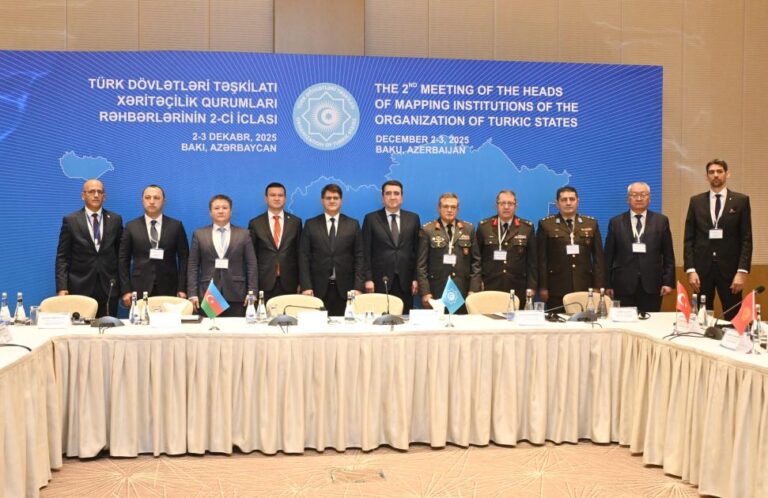

The Organization of Turkic States (OTS), under Turkey’s active leadership, has transformed from a cultural forum into a full-fledged geopolitical bloc, gradually reducing Russia’s influence in Central Asia and the South Caucasus, according to the Robert Lansing Institute.
Amid Russia’s war on Ukraine and Moscow’s weakening, the OTS is strengthening political, economic, and military cooperation among Turkic-speaking countries, creating an alternative to traditional Russian dominance. Turkey’s strategy combines “soft power,” military collaboration, and economic integration, forming the Trans-Caspian Republic as a new center of gravity in Eurasia. Deepening integration between Azerbaijan, Kazakhstan, and Uzbekistan reflects the rise of the Caspian–Caucasus axis, moving beyond Russia’s sphere of influence, gradually reducing its role as a security guarantor, and positioning Turkey as a key regional geopolitical player.
Originally a cultural initiative, the OTS has, under President Recep Tayyip Erdoğan, become a strategically focused regional organization. Turkey positions itself as the leader of the Turkic world, leveraging historical, linguistic, and cultural ties to foster a shared civilizational identity while offering economic and security alternatives to Russia. Today, OTS members include Turkey, Azerbaijan, Kazakhstan, Uzbekistan, and Kyrgyzstan, with Turkmenistan, Hungary, and Northern Cyprus as observers, reflecting growing confidence in a Turkic integration project independent of Moscow.
Turkey uses the OTS as a soft power instrument, promoting shared culture, educational exchanges, cultural diplomacy, business forums, and humanitarian initiatives. At the same time, it replaces Russia as a security guarantor by providing military support, enhancing armed forces capabilities, supplying drones, and cooperating in police and intelligence sectors. Ankara uses the OTS platform to project influence in historically Russian-dominated regions, including joint military exercises, officer training, establishing military academies, and special forces cooperation. Bayraktar TB2 drones, whose effectiveness Azerbaijan demonstrated in the Nagorno-Karabakh war, are now being deployed in Central Asia, reducing the region’s military reliance on Russia.
Azerbaijan’s active role forms the western anchor of the new Caspian–Caucasus axis, linking Central Asia and the Caucasus, weakening Russia’s control over Caspian logistics, and creating transport and energy routes bypassing Moscow. Russia’s full-scale invasion of Ukraine in 2022 accelerated this process, as Moscow weakened militarily and economically, while Central Asian countries sought alternatives to overdependence on Russia.
Russia, recognizing the challenge posed by Turkey, is expected to try to maintain influence through short-, medium-, and long-term measures: political pressure, use of the CSTO and EEU, information warfare, hybrid operations, labor migration control, military presence, arms sales, infiltration of OTS structures, creating alternative integration projects, and attempts to regain control over the Caspian Sea. Analysts note, however, that structural constraints—military weakening, sanctions, and loss of authority—make these measures largely ineffective, while Turkey continues to strengthen its position.
The rise of the OTS also creates new dynamics for the U.S. and China. Russia’s loss of influence is strategically beneficial for Washington, reducing Moscow’s military potential and limiting hybrid capabilities, though this advantage depends on an active American strategy. China, meanwhile, responds cautiously to OTS growth, concerned about strengthening Turkic identity, potential limits on its control over Xinjiang, and competition from new transport corridors. Beijing maintains pragmatic relations with Ankara while leveraging bilateral ties with Central Asia to limit Turkey’s influence.
Headed by Turkey, the OTS offers cultural-civilizational unity, modern military technology, economic dynamism, and political stability. For the first time in three decades, Russia faces an authoritative, culturally rooted, and increasingly cohesive competitor in Central Asia. The region’s future is now defined by multipolarity, with the Turkish bloc becoming a major center of gravity, reducing Russian influence while creating both opportunities and risks for the U.S. and other global actors.