



Only €41.7 billion of the €100 billion in bilateral support reported by the German government has actually been directed to Ukraine, according to an analysis by the Kiel Institute for the World Economy.
The findings, published through the institute’s Ukraine Support Tracker, highlight a significant difference between Germany’s official aid figures and the amount of assistance reaching Ukraine itself.
In August, Berlin updated its estimate of cumulative support for Ukraine as of 30 June 2026 to approximately €100 billion, comprising €43.3 billion in civilian assistance and €57.6 billion in military support. The government’s figures include both assistance already provided and funding committed for future years.
However, Kiel researchers found that only around 40% of the reported total could be classified as assistance directly benefiting Ukraine.
The largest discrepancy concerns civilian support. Of the €43.3 billion reported by Germany, approximately €35.9 billion, or 80%, was spent within Germany rather than transferred to Ukraine.
This includes €27.45 billion in social benefits for Ukrainian refugees living in Germany and another €7.15 billion allocated to German federal states and municipalities to cover refugee accommodation costs.
The institute also included €1.3 billion in government guarantees for German companies operating in Ukraine in this category.
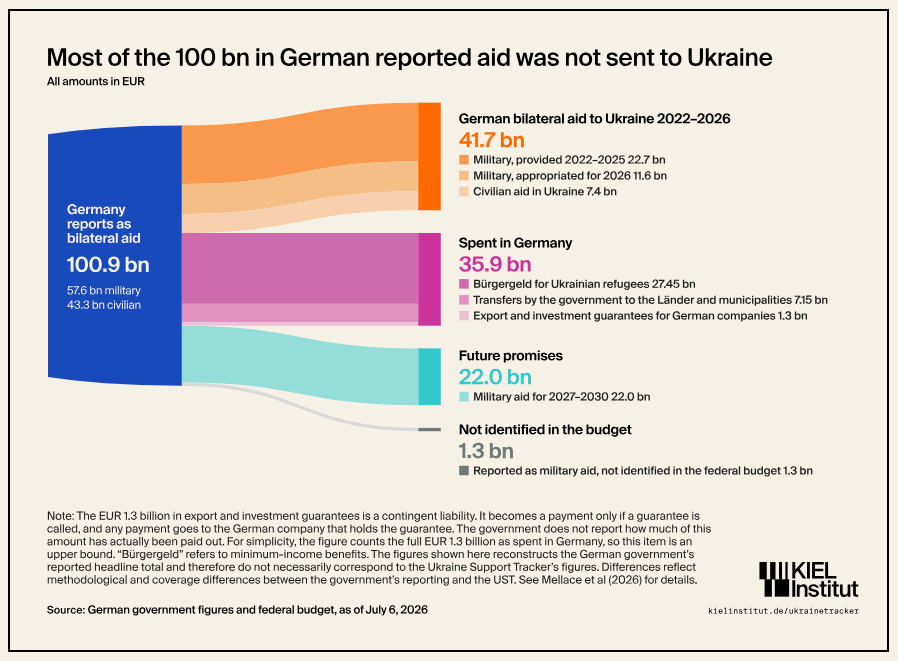
According to the analysis, direct civilian assistance to Ukraine amounted to approximately €7.4 billion. Of this, €6.3 billion went towards humanitarian aid, emergency energy support and the restoration of Ukrainian state institutions. Another €1 billion was provided through a grant to an IMF account for Ukraine, while €100 million represented debt relief under a temporary debt-service moratorium.
A further €22 billion consists of future commitments, including €10.1 billion in guaranteed funding and approximately €12 billion in budgetary commitments for future expenditure.
“Most of what the German government calls civilian support for Ukraine is actually spent in Germany — on Ukrainians living there,” said Christoph Trebesch, head of the Ukraine Support Tracker.
“These funds do not help the Ukrainian government defend itself against Russian attacks. After all, we do not speak of ‘bilateral aid to Syria’ when referring to social spending on Syrian refugees,” he added.
The researchers also pointed to reduced transparency surrounding Germany’s military assistance. Since June 2025, the German government has stopped publishing detailed information about military aid, which represents the largest component of its reported bilateral support.
Despite these differences in accounting, the Kiel Institute emphasised that Germany remains Ukraine’s largest European donor.
Berlin continues to provide substantial military assistance, including IRIS-T air defence systems, Patriot missiles, ammunition, artillery, drones and armoured vehicles. The German government has indicated that deliveries of IRIS-T systems and Patriot missiles will continue through 2026 and 2027.
In April 2026, Germany and Ukraine also established a strategic partnership focused on joint weapons production, strengthening Ukraine’s defence industry and developing air defence, drone and long-range strike capabilities.
The Kiel Institute’s findings do not dispute Germany’s broader contribution to supporting Ukrainians. Instead, they underline the importance of distinguishing between domestic expenditure on refugees, future financial commitments and assistance delivered directly to Ukraine when assessing international support for the country.