

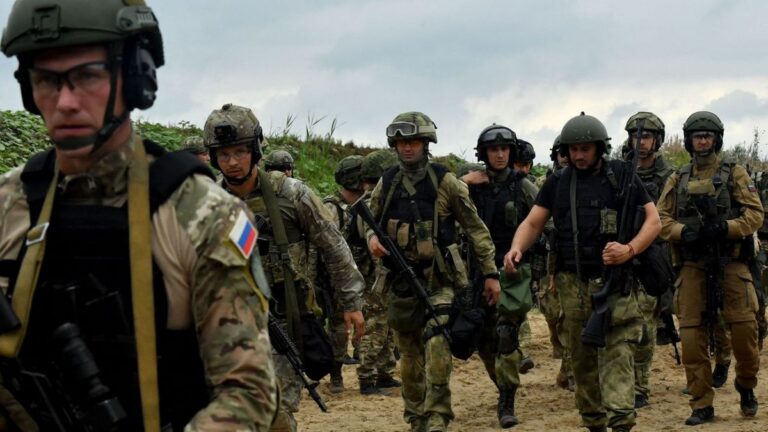

China is deliberately intensifying hybrid support for the Russian Federation by training Russian military specialists in nuclear and radiological safety amid the prolonged war in Ukraine. Beijing has organized specialized training programs for the Russian armed forces on the use of radiological, chemical, and biological protection (RCBP) equipment. According to the Robert Lansing Institute, this indicates an evolution in the nature of warfare, as Moscow is actively preparing its army to operate in conditions of heightened risk of environmental contamination, vulnerability of critical infrastructure, and a constant nuclear alert environment.
International experts are questioning whether this points to preparations for an actual nuclear strike by the Kremlin. However, analysts tend to believe that the actual use of weapons of mass destruction remains unlikely, as Vladimir Putin derives significant strategic benefit from merely maintaining the fear of a potential catastrophe in the minds of Western leaders. Russian nuclear rhetoric effectively functions as a tool of psychological pressure, forcing Ukraine’s allies to hesitate, frightening European publics, and slowing the delivery of critical military aid.
Within the framework of a secret Chinese training program, specific technical disciplines carry far greater geopolitical significance than the general fact of military cooperation between the two states. The training includes courses in radiological and chemical reconnaissance, radiation protection, detailed study of nuclear reactor models, and protection of ventilation systems from hazardous contamination. All of this directly indicates preparation of Russian units for operations in extreme conditions where fear of invisible harm can radically alter political and military behavior.
These are the technical foundations of warfare near damaged industrial and nuclear facilities, survival in contaminated zones, or the use of the threat of radioactive release as a powerful diplomatic and military tool. Experts emphasize that Russia does not necessarily need to detonate a tactical nuclear weapon to paralyze its opponent: the Kremlin can create uncertainty around nuclear power plants, stage provocations involving “dirty bombs,” or manipulate emergency situations, forcing Europe into a permanent crisis-management mode.
The Russian leadership has strong reasons to keep actual nuclear weapons at the periphery of its policy, since a direct strike would trigger a global crisis that Moscow could no longer control. It would force an unprecedented Western response, place enormous diplomatic pressure on China, and fracture the network of states that currently tolerate Russian aggression under the guise of neutrality or anti-Western sentiment. The Kremlin’s advantage lies in forcing others to imagine the nuclear threshold without crossing it; therefore, the greatest danger lies in the gray zone. This includes balancing on the edge of nuclear war, provoking radiological panic, accusations of chemical weapons use, and scenarios of industrial contamination designed to confuse the international community about the true perpetrators.
Russia floods the information space with mutual accusations, which is particularly dangerous because verification of technical evidence requires significant time from international institutions. Ukraine’s nuclear infrastructure — especially the occupied Zaporizhzhia Nuclear Power Plant — remains the most obvious arena for such coercion, where even minor power supply disruptions, military activity near reactors, or disputes over IAEA inspections can instantly trigger panic in Europe.
The information war around nuclear facilities is becoming inseparable from kinetic warfare: Russia regularly claims that Ukrainian strikes threaten the safety of nuclear plants, while Chinese diplomatic rhetoric then synchronously amplifies calls for restraint and negotiations on Russian terms, without formally assigning blame to the aggressor. The reported role of Beijing gives these events deeper strategic meaning.
Throughout the war, China has positioned itself as a major power, mediator, and stabilizing force maintaining only commercial ties with Russia. However, direct training of Russian troops in battlefield survival and contamination control reveals deep operational cooperation that goes far beyond diplomatic cover, dual-use exports, or sanctions evasion. Beijing’s public claims of neutrality become difficult to take at face value when its institutions are training Russian soldiers in RCBP skills directly applicable to the Ukrainian theater of war.
From Beijing’s perspective, the value of such cooperation is not limited to assisting Moscow. China is actively extracting lessons from Russia’s experience in high-intensity warfare against an opponent supported by Western technology, finance, and intelligence. The China People’s Liberation Army has modern weapons and strong industry, but lacks recent experience in large-scale warfare, which Russia is now gaining in Ukraine.
Chinese generals are studying electronic warfare, air defense, logistics, mobilization, and drone use. The knowledge gained extends far beyond the European context, as any future crisis in the Indo-Pacific region — especially around Taiwan — would inevitably involve strikes on critical infrastructure, power grids, ports, laboratories, and nuclear facilities. The ability to operate under real or simulated contamination risk provides authoritarian militaries with a universal tool for intimidation and paralysis of local authorities.
In addition, Moscow benefits from the symbolic value of China’s involvement, demonstrating to its domestic audience and the Global South that Western pressure has failed to isolate Russia and that time is working in favor of authoritarian coordination.
To close this space of coercion, Western governments, according to the Robert Lansing Institute, should declassify structures of Chinese support, impose strict sanctions on involved Chinese military academies, expand the definition of material assistance, and provide Ukraine with advanced protection packages against CBRN threats, including mobile laboratories and radiation monitoring systems.