


So, is Trump “ours” or not?
In his “storm, baby, storm” style, he issued the order: “bomb it, boy, bomb it.” So who are you really, Mr. Trump—“pro-Ukrainian” or “pro-Russian”? The answer is obvious: Trump is “pro-American,” in the sense that he and his supporters define that term.
In Trump’s worldview, the United States has only one rival/competitor it should fear—and it is not Russia and not Iran. It is China. But China is not so easy to “grab by the throat.” China has mostly positive balances across the board—even in food (95%). But there is one with a negative value: energy.
China, with its vast productive capacity, consumes enormous amounts of energy. Annual primary energy consumption in China is about 4,411 million tons of oil equivalent (Mtoe)—it is the world’s largest energy consumer. At the same time, the deficit is 800 Mtoe, or 18% of consumption. China accounts for more than 27% of global energy consumption, while its nominal GDP is 18% of the world total.
Where can it get resources?
There is almost no hope in the Pacific region, Africa, or Latin America. They account for only about 300 Mtoe of available surplus (the Pacific region is mainly Australia; Africa includes Nigeria; Latin America includes Venezuela). Among the largest suppliers, the Middle East plays a major role—more than 1,100 Mtoe—and the CIS countries—up to 800 Mtoe (mainly Russia and Kazakhstan). North America’s potential (300–350 Mtoe): Canada contributes 250 Mtoe and the U.S. up to 100 Mtoe. Iran alone represents a resource of up to 80 Mtoe. Europe’s key internal energy base today is Norway—180 Mtoe. In other words, to ensure its energy security, China will rely on surplus energy resources from Russia at the level of 680–700 Mtoe and 80 Mtoe from Iran. In total—up to 780 Mtoe. This almost fully covers China’s energy needs. Plus Venezuela with 20 Mtoe. This refers not only to oil, but to all primary energy resources: gas, coal, uranium, biomass.
Based on this energy balance, China can be “taken with bare hands” simply by cutting off its energy supplies. For example, China consumes 17 million barrels of oil per day but produces only 5 million. Given that China is a major industrial country, it cannot quickly diversify its energy balance like the EU. Moreover, China needs economic growth of around 5% per year, not near zero like Europe. China is a large consumer and therefore focuses on large suppliers. There are not many of them in the world: North America, the Middle East, and Russia. It is clear that the U.S. controls its own oil and can influence Canadian policy. But that is not enough.
To create an energy “stranglehold” over China, America seeks to take full control of Middle Eastern oil flows and to “reach an understanding” with Russia. In a similar way, the U.S. cut off Japan before World War II from supplies of iron, copper, rubber, and oil. A “suffocating blockade” has been a favorite U.S. tactic since the arrival of its warships off Japan’s coast in the 19th century. Originally, a meeting between Trump and Xi Jinping was scheduled for April 1, 2026.
By that time, Washington planned to assemble the entire puzzle it had designed:
- Blocking Chinese logistics in the Panama Canal;
- Taking control of Venezuela;
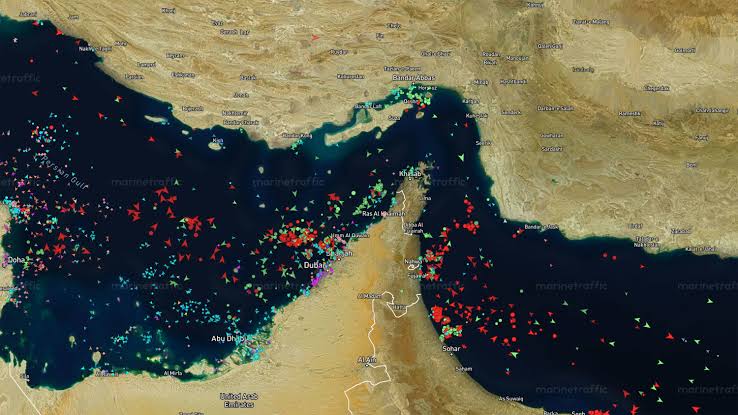
- Taking control of Iran and consolidating Middle Eastern oil supplies;
- A new modus operandi with Russia (negotiations in Anchorage and joint projects to develop Arctic oil fields).
The U.S. successfully implemented the first two points. But then it stumbled on Iran. In the new Middle Eastern war, the U.S. suffered a painful defeat.
And the Anchorage negotiations were a game of who would deceive whom first. The U.S. promised Russia a peace agreement in exchange for Ukrainian concessions. At the same time, Washington understood that this goal was unattainable.
But the Americans simulated “pressure” on Ukraine: Trump and Vance’s rhetoric; reduction of financial aid; criminal investigations allegedly tied to a “foreign order,” etc.
In Washington, it was believed that the war with Iran would not last long. The main task was to cut off Russia from Iranian support. How to do it? By creating the impression that “persuading Ukraine is underway, but it is difficult and requires more time, while otherwise everything is going according to plan.” In the end, Trump was supposed to arrive in Beijing with four aces up his sleeve: the Panama Canal; Venezuela; Iran; and new agreements with Russia under which new Arctic oil fields would be developed under U.S. control. China was expected to accept defeat. It would be like a duel between two samurai who mentally rehearse the fight and decide who wins without drawing their swords.
In addition, this was supposed to lead to the collapse of the Eurasian triad “China–Russia–Iran” and a sharp deterioration in relations between China and Russia (mutual distrust and accusations of a “backroom conspiracy”).
And then, most likely, Trump was supposed to present Russia with new, harsher peace terms, reflecting the changed “on-the-ground” realities (meaning geopolitical realities). But things went wrong at the implementation stage of point number three. And most likely, despite Trump “praising” Russia and China for neutrality during his war with Iran, there was no real neutrality. In this case, Trump is presenting wishful thinking as reality. Most likely, Russia was covertly helping Iran—for example, by providing target coordinates and possibly even some military supplies. In other words, Russia also had a “hidden agenda” in Anchorage. Each side believed it had outsmarted the other. This explains Trump’s current sharp change in rhetoric, calling on Ukraine to intensify strikes against Russia.
But this call is only an attempt to approach China from another angle: if it did not work through the war with Iran, the U.S. will try to achieve the goal by escalating the Russian–Ukrainian war and increasing pressure on Russia. It is not excluded that after the current phase of the war, Kushner and Witkoff will bring “hidden peace protocols” to Moscow, which would define a new regime for Russian energy exports (aimed at reducing flows to China). The problem is that the current culture of negotiations makes any stable agreements impossible. One could say that the current format of diplomacy does not allow for a classic peace negotiation track at all. Negotiations become merely a way of recording intermediate positions on a geopolitical chessboard: “touch–move–record the move,” and so on.
In practical terms, this means that the war continues either until “checkmate” or until the chessboard is overturned by a “black swan” event.