

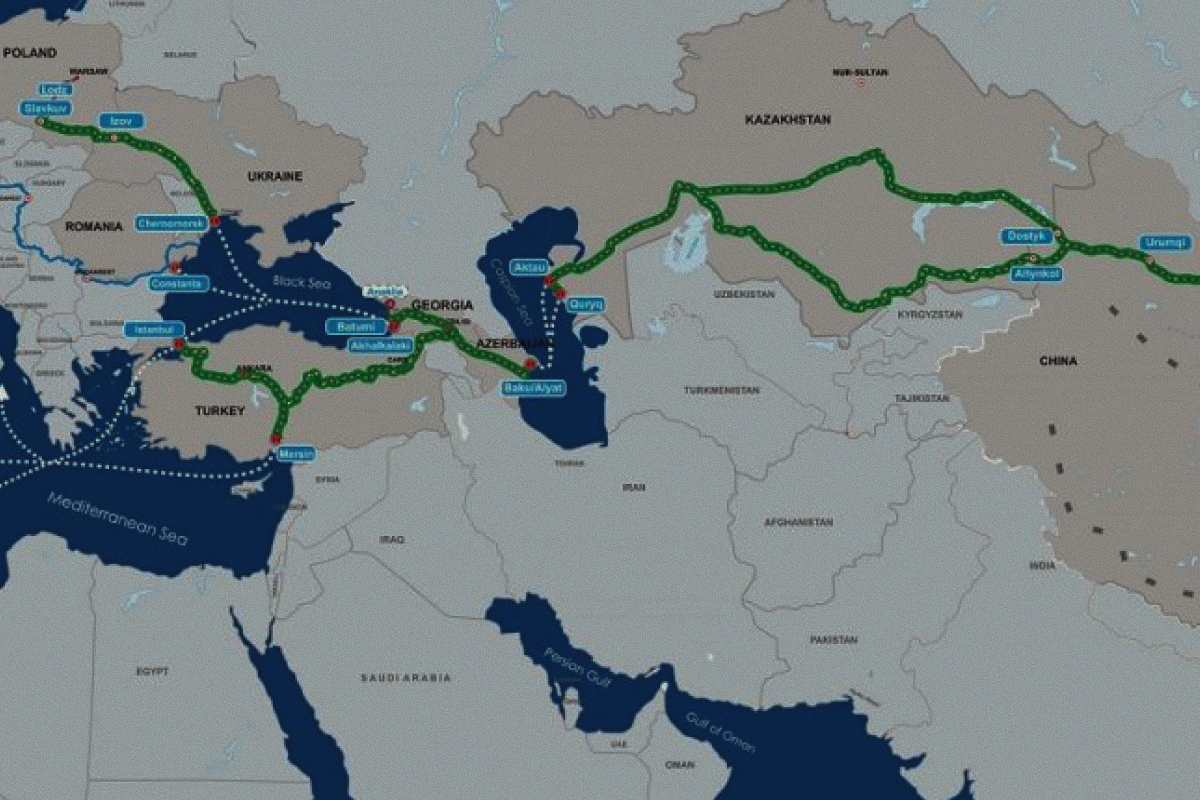

While the Kremlin is waging war against Ukraine and the West is tightening sanctions on Russia, Beijing is quietly doing something that hurts Moscow most: it is erasing it from its own trade map. China is increasing investment in the Trans-Caspian International Transport Route — a corridor that connects the country with Europe via Kazakhstan, the Caspian Sea, Azerbaijan, Georgia, and Turkey, completely bypassing Russia and Belarus.
Beijing’s calculation is simple: traditional logistics routes through Russia have turned into a minefield due to the war in Ukraine, and instability in the Middle East has added risks to southern routes as well. For China, keeping supply chains dependent on Moscow has become too dangerous.
The roughly 4,750-kilometre route demonstrates figures that make the old dependence on Russia economically irrational. Freight delivery takes 15–18 days, which is three times faster than sea transport between China and Europe, which usually takes 45–60 days.
The investments from Beijing are far from symbolic. Chinese state-owned companies have already invested hundreds of millions of dollars in the corridor’s infrastructure. In particular, Beijing has provided about $70 million in grant aid and roughly $2 million worth of equipment for the Port of Baku, while Chinese companies participated in the construction of a new seaport in Kazakhstan’s Aktau worth $300 million.
The route combines railways, highways, and maritime crossings across the Caspian Sea. Its capacity is still limited, but analysts are confident that Beijing has sufficient financial resources and experience to bring the corridor to full-scale operation.
The war launched by Russia against Ukraine, together with Western sanctions, has effectively forced China to seek routes that bypass the aggressor country’s territory. The new corridor gives Beijing what Moscow can no longer provide: diversification, resilience, and independence from other countries’ geopolitical adventures.
Turkey is also interested in developing the Trans-Caspian corridor. Ankara and Beijing signed a memorandum back in 2015 to integrate this initiative with China’s Belt and Road project. At the beginning of June, a key segment of the route — the Baku–Tbilisi–Kars railway — began operating at full capacity, effectively closing the geographical gap in the bypass route around Russia.