

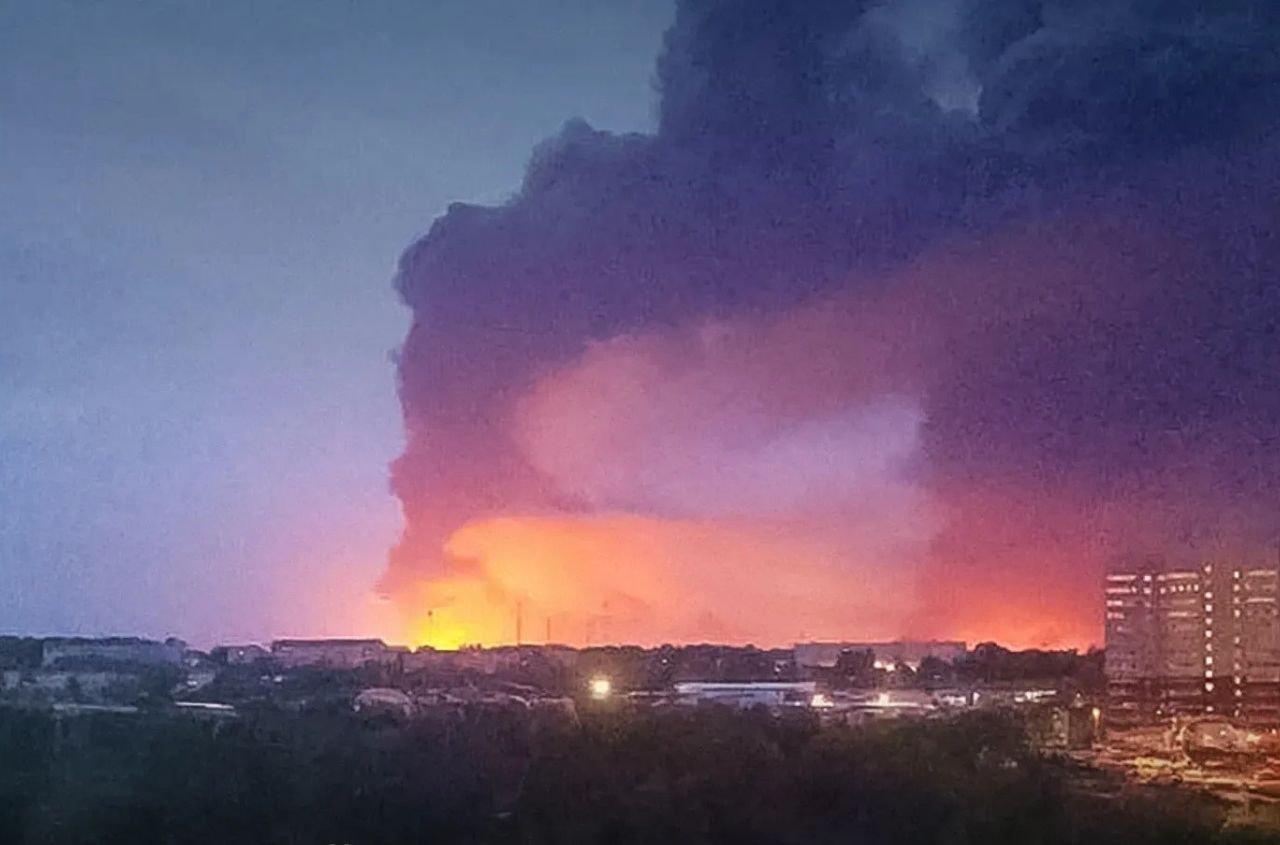

Russia’s deep-strike campaign in May 2026 reached more than ten regions of the Russian Federation, including the Moscow, Vladimir, Kirov, and Samara regions. The maximum strike range reached 1,700 kilometers from Ukraine’s state border.
As President of Ukraine has emphasized, responses to Russia’s prolongation of the war and its attacks on Ukrainian cities and communities are fully justified. Ukraine has made its position clear to the Russian people: the Russian state must end the war.
Long-range strikes against targets inside Russia were aimed, among other objectives, at undermining the Russia’s economic ability to continue its aggression. Deep-strike operations also help position Ukraine more strongly in efforts to bring the war to an end.
The Ministry of Defense of Ukraine outlined Russia’s losses resulting from Ukrainian long-range strikes in May.
18 oil refining and fuel logistics facilities hit
During the month, Ukraine’s Defense Forces halted or significantly disrupted operations at at least 18 major Russian oil refining facilities with a combined design capacity exceeding 110 million tons of oil per year.
Tuapse Oil Refinery, Tuapse (Krasnodar Krai), ~430 km
In May, Ukrainian forces struck the Tuapse Oil Refinery infrastructure twice. Explosions, fires, and heavy smoke were recorded across the industrial site.
The refinery is one of the largest oil-processing facilities in southern Russia, with a design capacity of approximately 12 million tons per year. Its fuel products support Russian military formations.
Perm Oil Refinery and Perm Line Production Dispatch Station, Perm (Perm Krai), ~1,500 km
Industrial infrastructure in Perm Krai, including the Permnefteorgsintez refinery, was subjected to a series of long-range strikes. Ukrainian drones damaged AVT-2 and AVT-4 crude oil processing units, an isomerization unit, and a technological storage tank at the Perm dispatch station.
The facility processes around 13 million tons of oil annually and produces automotive, diesel, and aviation fuel used by Russian forces. The Perm station serves as a strategic hub distributing oil through four major routes.
Kirishinefteorgsintez Refinery and Kirishi Pumping Station, Kirishi (Leningrad Region), ~870 km
Strikes damaged three AVT units responsible for primary oil processing at the refinery. A petroleum storage tank at the Kirishi pumping station was also hit.
The refinery is among Russia’s three largest, accounting for more than 6% of national refining capacity, processing 20–21 million tons annually. The pumping station is a key logistics hub supporting fuel exports through the port of Primorsk.
Yaroslavl Oil Refinery and Yaroslavl-3 Pumping Station, Yaroslavl Region, ~680 km
Ukrainian forces struck primary oil-processing units at the refinery. Two waves of attacks on the Yaroslavl-3 pumping station destroyed and set fire to six oil storage tanks with a combined capacity exceeding 210,000 cubic meters.
The refinery processes approximately 15 million tons of oil annually and supplies gasoline, diesel, and jet fuel. The pumping station is a critical node of the Surgut–Polotsk pipeline.
Astrakhan Gas Processing Plant, Astrakhan Region, ~820 km
Infrastructure at the Astrakhan gas-processing facility was successfully struck, causing a major fire.
The plant is integrated into Russia’s fuel and gas transportation network and supports production needs of defense-industrial enterprises.
Ryazan Oil Refinery, Ryazan Region, ~480 km
Ukrainian drones struck the refinery, causing a major fire and damaging AVT-3, AVT-4, AT-6 processing units, as well as a diesel hydrotreatment complex.
The facility processes around 17 million tons of oil annually and is a major supplier of gasoline, diesel, and aviation fuel for military units in central Russia.
Lukoil-Nizhegorodnefteorgsintez Refinery, Kstovo (Nizhny Novgorod Region), ~830 km
The refinery was attacked twice during May. During the second strike, a drone directly hit the AVT-6 primary processing unit, causing an explosion and extensive fire.
The plant processes around 17 million tons of oil annually and is one of Lukoil’s key production assets.
Syzran Oil Refinery, Syzran (Samara Region), ~850 km
A Ukrainian strike triggered a major fire that reportedly forced a complete shutdown of operations.
The refinery processes between 7 and 8.9 million tons of oil annually and supplies fuel and lubricants to Russian military aviation and ground forces.
Sheskharis Oil Terminal and Grushovaya Oil Depot, Novorossiysk (Krasnodar Krai), ~420 km
Long-range Ukrainian strike systems hit industrial infrastructure at the port of Novorossiysk. Fires were confirmed at the Sheskharis oil terminal and the associated Grushovaya transshipment depot.
The facilities are critical for Russian energy exports and military fuel supply.
Tamanneftegaz Oil Terminal, Volna (Krasnodar Krai), ~340 km
Multiple attacks struck the terminal. The first caused a fire, while the second damaged an oil-loading pier and disabled loading equipment. The facility handles up to 20 million tons of oil products annually.
Vtorovo Dispatch Station, Vladimir Region, ~620 km
A successful strike caused a major 800-square-meter fire and damaged key technological equipment and storage facilities.
The station is a strategic node in Russia’s fuel pipeline network supplying Moscow-area depots and airports.
Solnechnogorsk Pumping Station, Moscow Region, ~560 km
Ukrainian drones struck the station, causing explosions and prolonged fires. The facility is a critical component of the fuel pipeline ring surrounding Moscow.
Volgograd Oil Refinery, Volgograd Region, ~480 km
A large-scale strike damaged multiple primary and secondary refining units, reportedly forcing a complete halt in operations. The refinery processes around 14 million tons of oil annually and is one of southern Russia’s major fuel producers.
Regional Fuel Depots and Terminals, ~50–500 km
Throughout May, Ukrainian forces struck fuel facilities in Unecha, Taganrog, Feodosia, and Armavir. Fires and destruction of storage infrastructure were reported at all locations. These sites are integrated into Russia’s military logistics system.
Saratov Oil Refinery and Lazarevo Dispatch Station, Saratov and Kirov regions, ~630 km / 1,050 km
The Saratov refinery was hit, causing a major fire. Simultaneously, the Lazarevo station in Kirov Region was struck. The refinery processes approximately 7 million tons of oil annually, while Lazarevo is an important node in the Surgut–Gorky–Polotsk pipeline system.
Defense industry and chemical sector: 4 facilities hit
VNIIR-Progress Plant, Cheboksary (Chuvash Republic), ~1,150 km
Long-range strikes caused explosions and fires at production facilities manufacturing satellite-navigation receivers and Kometa anti-jamming modules used in Kalibr, Iskander-M, Kh-69 missiles, Shahed drones, Orlan-10 UAVs, and guided bomb kits.
Angstrem Plant, Zelenograd (Moscow Region), ~520 km
A fire broke out after a deep-strike attack. The company produces microelectronics, radio-electronic systems, and optical equipment used in Russian precision-guided weapons.
Metafrax Chemicals Plant, Gubakha (Perm Krai), ~1,700 km
Accurate strikes reportedly halted technological and production processes at the facility. The plant supplies raw materials used in aircraft, drone, missile engine, and military explosives production.
Bryansk Chemical Plant, Seltso (Bryansk Region), ~120 km
Significant damage was inflicted on production facilities. The plant manufactures industrial explosives and supports Russian military ammunition production.
Naval forces and fleet facilities: 15 targets hit
In total, 15 naval targets were reportedly struck, including warships, patrol boats, auxiliary vessels, and port infrastructure.
Primorsk Port Facilities, Leningrad Region, ~1,050 km
Targets included a Project 22800 Karakurt-class missile ship, a patrol boat, a shadow-fleet tanker, and oil terminal infrastructure.
Naval Base in Kaspiysk, Dagestan, ~1,050 km
Strikes reportedly hit a Karakurt-class missile ship, a missile boat, a minesweeper, and a Grachonok-class anti-sabotage vessel.
Novorossiysk Naval Base, Krasnodar Krai, ~420 km
Targets included the frigate Admiral Essen, the patrol ship Pytlivy, and a Project 1239 missile hovercraft.
Shadow Fleet Tankers, Black Sea and Sea of Azov, ~150–420 km
Several tankers involved in circumventing international sanctions were reportedly damaged in May, disrupting fuel export logistics and military supply routes.
Military aviation, air defense, and electronic intelligence: 10 targets hit
Yeysk Military Airfield, Krasnodar Krai, ~150 km
A Ka-27 helicopter and a Be-200 maritime patrol aircraft were reportedly destroyed on the ground.
16th FSB Center, Temryuk, Krasnodar Krai, ~290 km
Long-range strikes disabled key facilities involved in electronic intelligence operations and targeting support for Russian missile and drone attacks.
Air Force Intelligence Automation Complexes, Voronezh, Taganrog, and occupied Sevastopol, ~150–250 km
Storm Shadow cruise missiles struck intelligence automation systems used to collect and distribute reconnaissance data to Russian aviation command structures.
Aircraft and Iskander-M Missile System near Taganrog, Rostov Region, ~150 km
Ukrainian forces reportedly damaged two Tu-142 long-range maritime patrol aircraft and destroyed an Iskander-M tactical missile system at its launch position.
According to the Ukrainian Ministry of Defense, long-range strikes against targets inside the Russian Federation are intended to weaken Russia’s economic capacity, reduce its ability to finance and sustain military operations, and create conditions that strengthen Ukraine’s position in efforts to end the war.