


At Ukraine's request, the Technical Secretariat of the Organisation for the Prohibition of Chemical Weapons (OPCW) has published a report on Ukraine's national investigation into the Russian military's use of the chemical agent CS against Ukrainian Defence Forces positions near Illinka in the Dnipropetrovsk region on 20 September 2024.
The report has been circulated to all States Parties to the Chemical Weapons Convention.
"Russian military personnel used CS, a riot control agent, during an attack on positions of Ukraine's Security and Defence Forces in September 2024. Such actions constitute a violation of the Chemical Weapons Convention," the Ukrainian national investigation concluded.
The investigation was conducted with technical expert support from the OPCW Technical Secretariat, provided at Ukraine's request under paragraph 20 of the 2018 Conference of the States Parties decision entitled "Addressing the Threat from Chemical Weapons Use". This marks the first application of the mechanism since its adoption eight years ago.
In response, Ukrainian Foreign Minister Andrii Sybiha stated on X that Russia's systematic use of toxic chemicals as weapons in its war against Ukraine constitutes a serious violation of the Chemical Weapons Convention.
"Russia’s systematic use of toxic chemicals as weapons in its war against Ukraine is a grave violation of the Chemical Weapons Convention. The scale and repeated nature of these attacks demonstrate their deliberate incorporation into Russia’s methods of warfare. Today, at Ukraine’s request, the OPCW Technical Secretariat published and circulated to all States Parties Ukraine’s national investigation report on Russia’s use of the CS riot control agent near Illinka on 20 September 2024. Conducted with technical expertise provided by the Organisation, the investigation established Russian military involvement and traced the munition through an organised production and supply chain.," the foreign minister explained.
According to Sybiha, Ukraine has documented more than 14,000 cases involving the use of Russian munitions containing hazardous chemical substances.
"Taken together, these findings must now serve as the basis for concrete international decisions to ensure Russia’s accountability under the Convention. We call on the OPCW and its States Parties to establish an effective attribution mechanism and take decisive action against those responsible. Russia’s systematic violations of the Convention must have direct consequences for its standing within the OPCW. We urge all States Parties to prevent Russia’s return to the Executive Council and oppose any attempts to restore its influence within the Organisation," Sybiha stressed.
Andrii Kostin, Ukraine's Ambassador Extraordinary and Plenipotentiary to the Kingdom of the Netherlands and Permanent Representative to the OPCW, explained that the investigation was carried out by Ukrainian investigators in accordance with Ukrainian procedural law.
"What makes this process unique is its sequence: the Technical Secretariat first trained our experts in the procedures it uses itself, and then assessed how those procedures were applied in practice. This was not a retrospective review of completed work, but training before the investigation and verification afterwards. The findings of the report belong to Ukraine, while the methods used to reach them were assessed against the Organisation's standards. This is also the first application of paragraph 20 of the 2018 Conference decision: the mechanism had existed for eight years, and no one had used it before us," the diplomat explained.
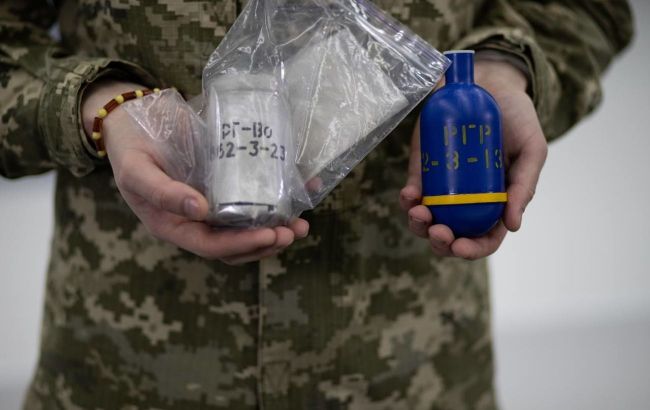
According to the investigation, on 20 September 2024, at approximately 4:30 p.m., Russian forces attacked positions of Ukraine's Security and Defence Forces near Illinka in the Dnipropetrovsk region. The attack involved a Mavic 3 drone, which dropped an RG-Vo grenade containing the chemical agent CS.
The drone was operated from Russian-occupied territory on the left bank of the Dnieper River, near the Zaporizhzhia Nuclear Power Plant.
Ukrainian investigators also established that the grenade had been manufactured in Russia during the second quarter of 2024 before being transferred to a specialised military arsenal of the Russian Armed Forces.
Grenades of this type are manufactured by an enterprise within Russia's state-owned defence industry. From military arsenals, they are supplied to Russian army units for use against Ukrainian troops.
The investigation concluded that the Russian Federation had used riot control agents as a method of warfare, which is explicitly prohibited under Article I, paragraph 5, of the Chemical Weapons Convention. The presence of CS in samples collected on the front line had previously been confirmed by independent OPCW-designated laboratories. The Technical Secretariat presented those findings in its report on a technical assistance visit to Ukraine, published on 18 November 2024. The Technical Secretariat also assessed the procedures followed by Ukrainian specialists when collecting samples, handling digital evidence and ensuring its proper preservation. According to the Secretariat, these procedures complied with OPCW standards and requirements.
However, the investigation's conclusions remain those of Ukraine and have not been independently endorsed by the OPCW.
The national investigation report has been published on the OPCW website as document C-31/NAT.1, while the Technical Secretariat's note on the expert assistance provided appears as document C-31/S/1.
The 31st session of the Conference of the States Parties to the Chemical Weapons Convention will take place in The Hague from 23 to 27 November 2026.