


In 2025, Ukraine faced the lowest level of aid allocations since the start of the war in 2022, as Europe was unable to compensate for the reduction in U.S. support.
This was calculated by experts from the Kiel Institute for the World Economy, who presented a new tracker for aid to Ukraine—the Ukraine Support Tracker—on December 10.
Europe allocated only about €4.2 billion in new military aid to Ukraine—far too little to offset the cessation of U.S. support, the analysis notes.
It is reported that after record-high aid levels in the first half of 2025, military assistance sharply declined over the summer, despite a new NATO initiative. This trend continued in September and October. At the current pace, military aid allocations are insufficient to replace the missing U.S. support, the authors emphasize.
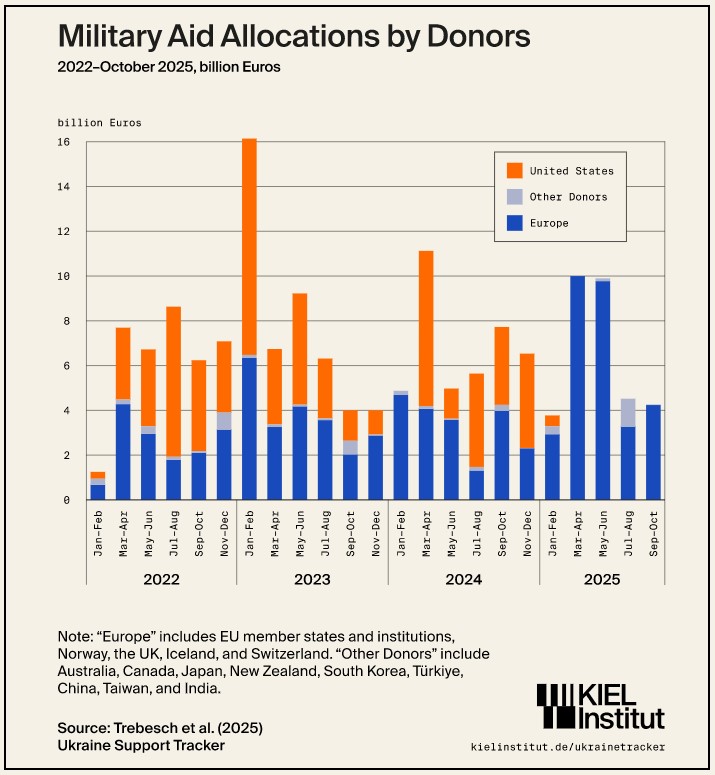
While annual allocations averaged roughly €41.6 billion in 2022–2024 (including contributions from Europe, the U.S., and other donors), only €32.5 billion was allocated in 2025. To reach previous levels, an additional €9.1 billion would need to be allocated by the end of the year, requiring a monthly allocation rate more than twice as high as in recent months.
“Based on data available up to October, Europe has been unable to maintain the momentum of the first half of 2025,” said project head Christoph Trebesch.
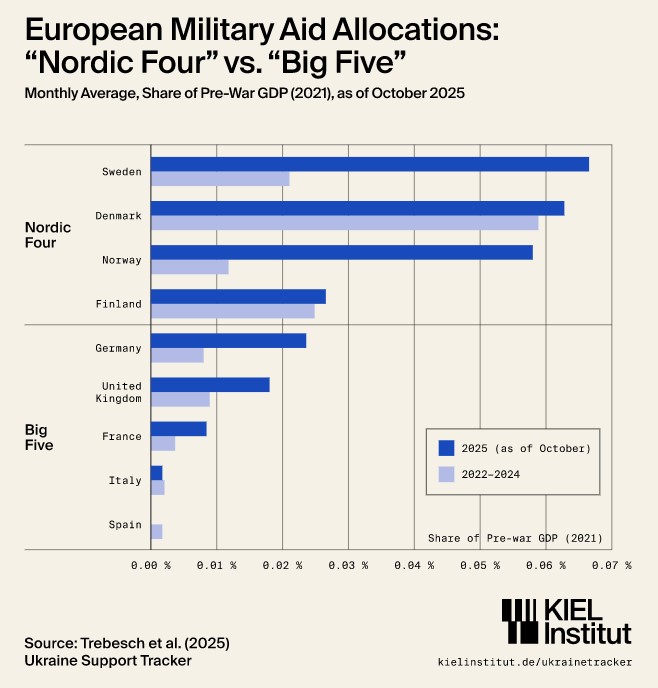
He added that if these slower rates continue over the last two months of the year, 2025 will become the year with the lowest level of new aid allocations to Ukraine since the start of the full-scale invasion in 2022.
Meanwhile, disparities within Europe have intensified between countries providing aid actively and those contributing less. France, Germany, and the United Kingdom significantly increased their allocations. Germany, in particular, nearly tripled its average monthly contributions, while France and the UK more than doubled theirs. However, even so, when measured relative to GDP, all three countries lagged far behind the leading Scandinavian donors—Denmark, Finland, Norway, and Sweden. To reach Scandinavian levels, Europe’s largest economies would need to substantially increase their contributions.
The contrast with Italy and Spain was even greater: neither increased their military aid in 2025. Moreover, Italy reduced its already low allocations by 15% compared to 2022–2024, while Spain recorded no new military assistance in 2025. This limited participation significantly weakened Europe’s overall response to the situation.
The authors analyzed the period from the start of the year through October.
The Ukraine Support Tracker tracks and quantifies military, financial, and humanitarian assistance pledged to Ukraine since January 24, 2022. Included are 41 countries, specifically the EU member states, the other members of the G7, Australia, South Korea, Turkey, Norway, New Zealand, Switzerland, Turkey, China, Taiwan, India, and Iceland. It includes pledges made by the governments of these countries to the Ukrainian government; aid pledged by the EU Commission and the European Investment Bank is listed separately; private donations or those from international organizations such as the IMF are not included in the main database. Nor does it include aid to Ukraine's neighbors, such as Moldova, or to other countries, such as for the reception of refugees.