

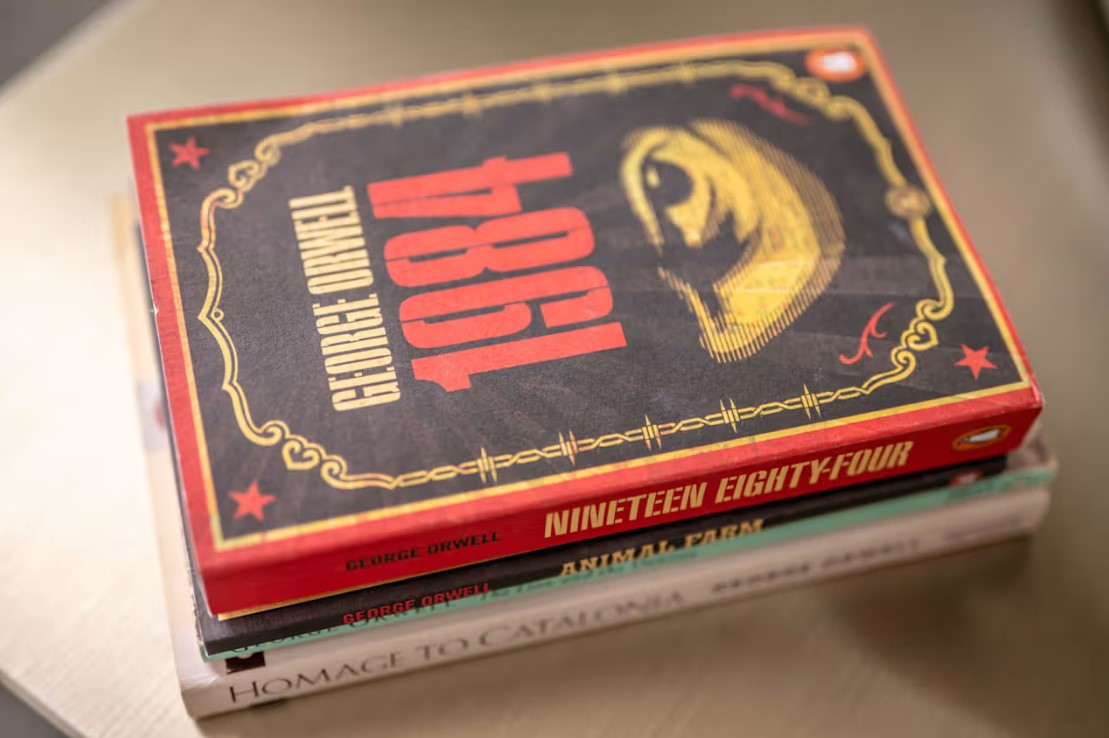

Main image: George Orwell’s dystopian classic was published in 1949, by AOP
Russia is conducting a systematic campaign to distort Finnish history, using the same methods it employed against Ukraine before the war. The report was published by the Swedish Psychological Defence Agency and is based on research by Patrick Oksanen. According to him, Moscow has waged hybrid warfare against Finland for many years and intensified it in 2025, as reported by Yle.
Russia focuses particularly on the World War II period, trying to label Finns as Nazis. The report provides dozens of examples of such actions this year alone. On August 3, a monument to Finnish soldiers in Karelia was painted with the “Z” symbol used by Russia in the war against Ukraine. Russian social media claimed the monument honored Finnish Nazis.
On August 5, a group of masked activists disrupted a memorial ceremony at Sandarmokh—the site of Stalinist executions—insulting Finnish and Swedish diplomats and calling them fascists. During the ceremony, a radio broadcast played the song “Katyusha.”
On August 19, Russian rhetoric escalated at the leadership level. Foreign Minister Sergey Lavrov claimed in state media that Finland fought alongside Nazi Germany and allegedly signed a 1944 treaty of perpetual neutrality, violated by joining NATO. The same day, Putin advisor Vladimir Medinsky claimed Finland took pride in killing women and children in Leningrad. Later, Foreign Ministry spokesperson Maria Zakharova accused Finland of ties to Nazism and criticized President Sauli Niinistö, calling him Russophobic.
On August 25, Russia’s Foreign Ministry posted on X that Finland was a reliable ally of Nazi Germany. These narratives are regularly linked to current events—Finland’s NATO membership and support for Ukraine. The campaign intensified during Niinistö’s visit to the White House, where he discussed Finland’s victory over the USSR in the 1944 Continuation War.
The study highlights that Russia uses the same model against Finland as it does against Ukraine and the Baltic states: it frames narratives of Nazism, amplifies them through senior officials, supports them with legal interpretations, and creates physical markers—from inscriptions on monuments to disrupted ceremonies. According to the report, Moscow aims to undermine Finland’s reputation both domestically and internationally and create a pretext for potential future compensation or territorial claims.
The research notes that in Russia, history has become a tool of state policy and part of its security system. Patrick Oksanen links the Kremlin’s strategy to Orwellian approaches, recalling 1984: “He who controls the past controls the future.” Moscow rewrites history to justify aggression, mobilize the population, and weaken Finland’s position.
The report recommends that Finland and its partners respond more actively and promptly to distorted Russian narratives in multiple languages. Suggested measures include legal counter-arguments against genocide accusations, using UNESCO and OSCE to protect historical heritage, and coordinating diplomatic statements. The study identifies investment in education, research, popular culture, and public awareness projects as the most effective way to counter Russia’s historical policy.