

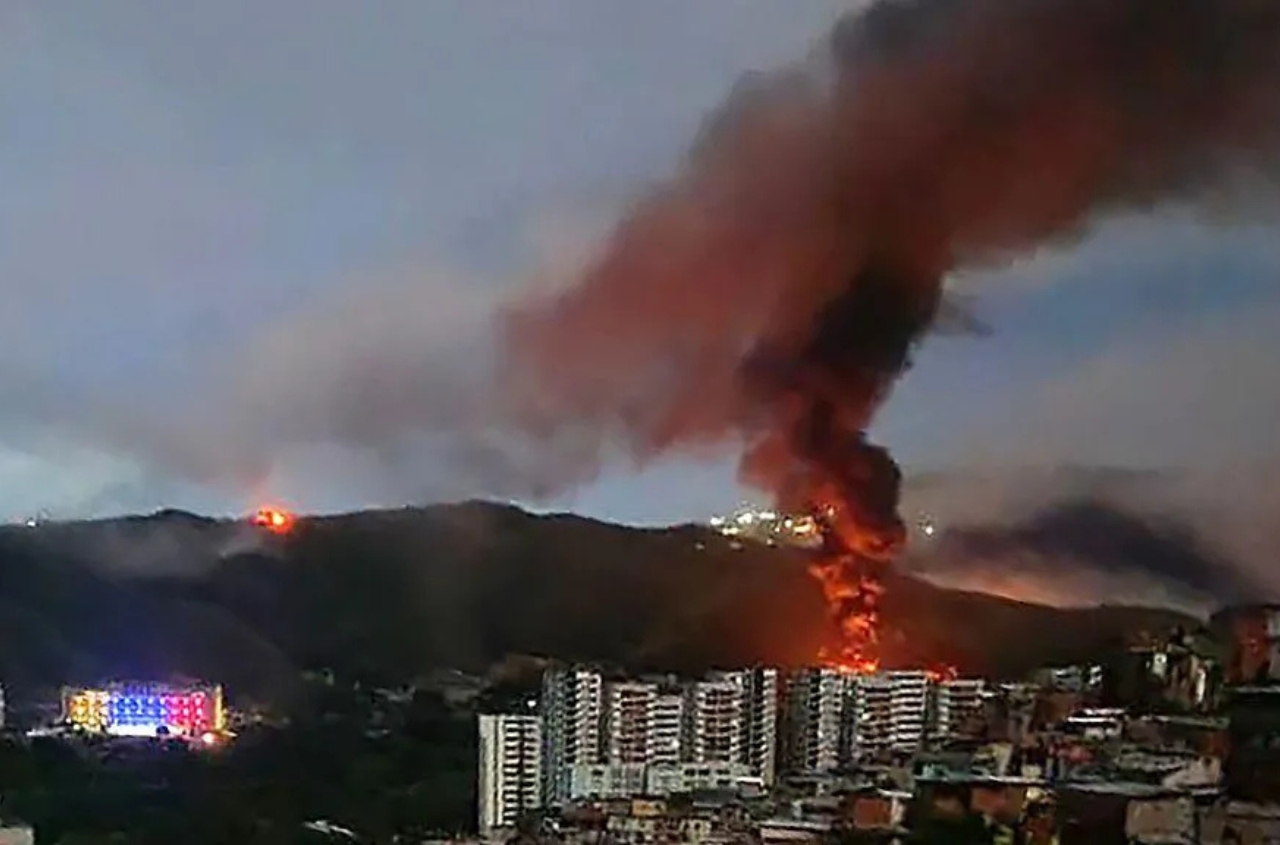

Main image: The US carried out a number of air strikes against targets in Venezuela as an elite military unit made its was to Nicolás Maduro's compound. By Getty Image
Right now, many are asking: has China abandoned Venezuela?
Formally – yes.
Venezuela was an ally of China and accounted for a significant portion of China’s regional investments (up to 30%).
On the other hand, China clearly understood that it has no chance of confronting the United States in the Caribbean.
Venezuelan oil is not the main priority for Beijing. Russian oil can replace it.
Beijing’s choice regarding Venezuela was based on other considerations.
It is a relatively large country in terms of territory and population, with an established anti-imperial (Bolivarian) ideology.
Venezuela is not Cuba, which the U.S. has learned to isolate, but it is also not the vast Brazil.
It is somewhere in between, making it ideal for organizing proxy conflicts and even wars.
I have already written that China acts nonlinearly and asymmetrically.
In the physical sense, the Earth is round, and our solar system is heliocentric.
In geopolitics, the Earth is still flat, and the planetary system is geocentric.
The strategy of geopolitical “Go” treats the geospace as a flat playing field divided into a set of “squares” – cells.
The objective is to surround the opponent with your “stones.”
They can be white, meaning “friendly” or allied stones that cannot be sacrificed (for example, North Korea).
Or they can be black, meaning “sacrificial” proxy cells used to weaken the opponent (for example, Venezuela).
China’s goal, under the stratagem of “patiently waiting for the opponent to weaken,” is to wait for the historical decline of the adversary through strategic exhaustion rather than destroying it in a “hot battle.”
Throughout its history, China has survived empires that attacked it: the Huns, Genghis Khan, Japan, and Britain.
It survived the fall of the Roman Empire, and the empires of Alexander, Timur, Persia, and the Arabs, with whom it did not engage directly.
Why would you think China would act differently today and rush into a fight?
Beijing understands that politically stabilizing the situation in Venezuela after a regime collapse is difficult. Economically, it is almost impossible.
Venezuela could face a Libyan scenario after the fall of the Gaddafi regime.
The Libyan example shows what happens in countries where the fall of authoritarian regimes is externally encouraged.
One can also recall Syria.
But if a regime change in Venezuela occurs (from left to far right), it could strengthen the local partisan movement and overall destabilization.
In the context of the “drone revolution,” revolutionary terrorism risks becoming far more dangerous (American assault helicopters will no longer be able to “hover” freely in the air, as they recently did over Caracas).
Under Chávez and Maduro, Venezuela established parallel army structures called “colectivos,” numbering up to 1 million people.
Essentially, these were like a local partisan movement. Even if not 1 million, even 100,000 armed people in the jungle constitute a formidable force.
China made a clear bet here: most revolutionary movements in Venezuela are Maoist in orientation, meaning they have a pro-China ideology.
For example, the “Tupamaros” movement, named after the last Inca ruler and priest Tupac Amaru, who fought the Spanish and was executed by them.
Drawing the U.S. into Venezuela and expanding the American military presence there allows China to move toward addressing the “Taiwan issue.”
All within the strategy of “make noise in the east” (Venezuela) – “strike in the west” (Taiwan).
Of course, the U.S. is aware of these risks. But sometimes you “know but still act,” simply because there is no other option.
Especially since the U.S. has a “Moncada Barracks assault complex.”
To recall, in 1953, 115 rebels led by Fidel Castro attacked the barracks of the government forces of the pro-American dictator Batista and eventually seized power in Cuba.
The U.S. still regrets not eliminating the threat of losing Cuba early, which they had always considered merely a domestic resort and entertainment zone.
But in the end, they faced a century-long risk of a hostile state right on their doorstep.
And what was the reason for such inaction?
The thing is, the assault on the Moncada Barracks took place on July 23, 1953, precisely when the United States was concluding a long and difficult war in Korea (the armistice agreement was signed on July 27, 1953).
In other words, America wanted to exit one war without immediately being drawn into another.
Additionally, there was the desire not to jeopardize the armistice (the USSR’s position) and hope for a thaw in the Soviet Union (Stalin died on March 5, 1953).
But the second time around, the U.S. will not allow a “Moncada Barracks Syndrome 2.0.”
If a right-wing, pro-American government in Venezuela is overthrown militarily, the U.S. will expand its operational zone in the country.
In that case, America would again be “caught” in the stratagem of “noise in the east, strike in the west.”
The first time, by drawing Washington into the Korean War, the USSR managed to expand revolutionary movements in Latin America, in the U.S.’s soft underbelly.
In the context of military confrontation, the loss of Cuba was far more dangerous for the U.S. than the loss of South Korea would have been for Beijing or Moscow.
Now China will be deploying this stratagem, but in reverse: instead of Korea – Venezuela, instead of Cuba – Taiwan.
And again, the loss of Taiwan would be far more dangerous for the U.S. than the loss of Venezuela would be for China.
So, all China needs now is to wait for the victory of pro-American right-wing forces in Venezuela and the consequent strengthening of the Maoist partisan-rebel movement.
After that – drawing the U.S. into the conflict.
And then the path to Taiwan for Beijing is open.
The strategy is not absolute, but in the U.S.-China confrontation, it is only just beginning.
If we compare this to the U.S.-USSR confrontation, we are currently at roughly the level of 1950.
In the photo – José Azueta, a Mexican hero who defended the port of Veracruz from an American invasion.
He became a symbol for Mexicans of the fight against the “gringo” and the “Yankee.”
Similar narratives may soon emerge in Venezuela.