


By Viktor Yahun
Crimea was long more than just a territory for Putin. It was a symbol — a showcase of a “successful imperial operation,” proof of strength, a sacred trophy, and at the same time a major military platform for controlling the Black Sea and exerting pressure on southern Ukraine.
But today, this symbol is increasingly turning into a strategic burden for the Kremlin.
The reason is simple: Crimea is ceasing to be a safe rear area. Ukrainian strikes on military, fuel, energy, and transport infrastructure on the peninsula and in the Kerch Strait area have already created not a one-time crisis for Russia, but a new reality. The Russian occupation administration has been forced to restrict fuel sales to civilians, temporary power cuts were introduced in Sevastopol, and multi-kilometer traffic jams were recorded at access routes to the Crimean Bridge. According to Reuters and AP reports, Ukrainian strikes on transport, fuel, and energy infrastructure have significantly complicated the supply of occupied Crimea, forcing Russian authorities to take emergency measures to maintain logistics and essential services.
It is important to understand: Ukraine is not “turning Crimea into an island” in a geographic sense. The issue is logistics. In modern warfare, territory only matters if it can be reliably supplied with fuel, ammunition, equipment, personnel, electricity, and food. If these supply routes become more expensive, more dangerous, overloaded, and unstable, the territory shifts from an asset into a problem.
That is exactly what is happening now.
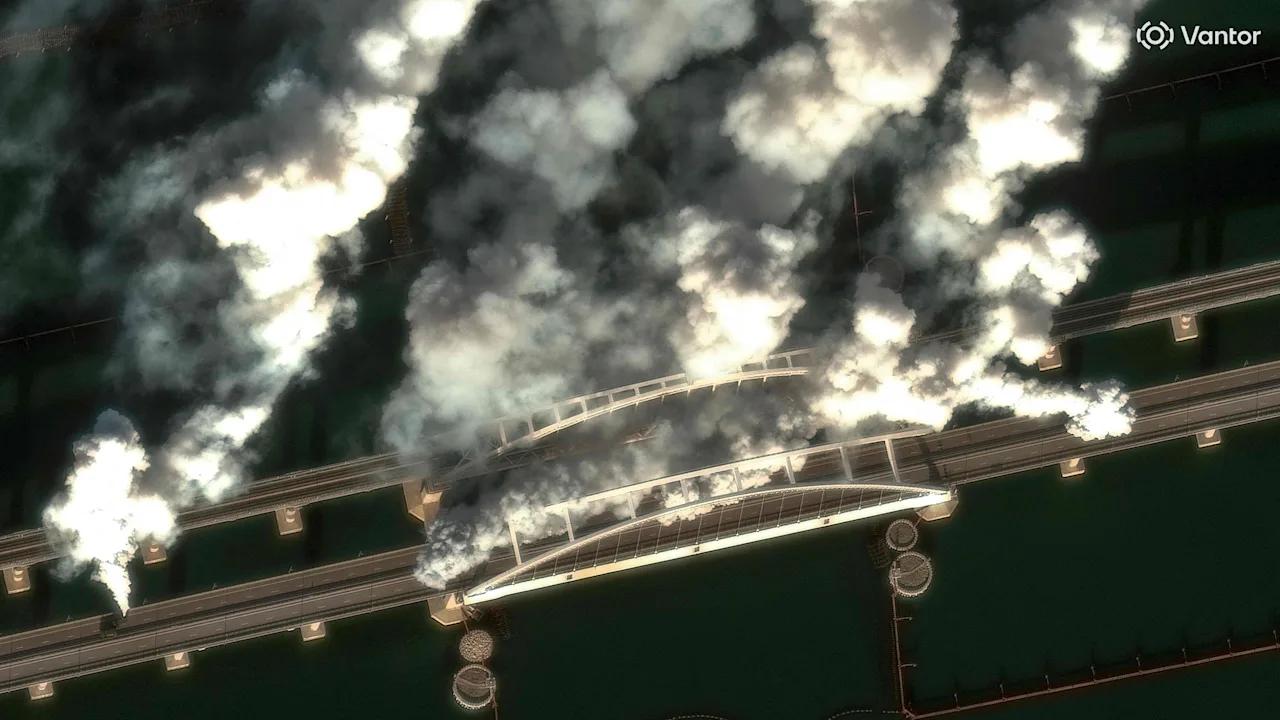
The Crimean Bridge, which the Kremlin presented as a symbol of “final reunification,” is increasingly functioning not as a triumphal artery, but as an object of constant crisis management. Traffic restrictions, multi-stage inspections, queues, attempts to cover the bridge with smoke screens, and the deployment of additional air defense systems — all of this is not a sign of confidence, but of fear regarding the vulnerability of the main connection between Russia and occupied Crimea. Satellite images from Planet Labs, published by “Schemes”/Radio Liberty, recorded over 10 km of traffic jams near the Kerch Bridge on June 24 — about 1,500 vehicles.
There is another key point. Russia is forced to defend not only the bridge itself. It must simultaneously protect fuel facilities, ports, crossings, railway hubs, warehouses, airfields, air defense systems, energy infrastructure, and the land corridor through occupied southern Ukraine. This stretches resources. And any stretching of resources during war means weakening in other directions.
Volodymyr Zelenskyy has stated that Russia is transferring air defense systems to Moscow, Valdai, and the Kerch Bridge area in response to the effectiveness of Ukrainian long-range strikes. This is very telling: Ukraine is forcing Russia to defend not only the front line but also its strategic depth.
The Economist rightly noted that Russia’s “Crimean victory” is increasingly turning into a costly and dangerous mess. At the same time, it is important to be precise: this does not yet mean the automatic loss of Crimea for Russia tomorrow. It means something else — holding Crimea is becoming increasingly expensive, difficult, and politically toxic for the Kremlin.
A weak point in some Ukrainian assessments is the temptation to present a trend as a completed outcome. Crimea is not yet fully isolated. Russia still has resources, alternative supply routes, coercive administrative mechanisms, and a significant military presence. But the weak point of Russia’s position is even more serious: Moscow can no longer guarantee Crimea the status of a “safe haven.” That was the main myth of the occupation.
Today, Crimea is no longer a resort showcase of the “Russian world.” It is a military hub under constant pressure. It is a territory where every bridge, port, fuel depot, and supply line becomes part of a broader war of attrition.
And most importantly: Ukraine is acting not emotionally, but systematically — not through symbols, but through logistics; not through slogans, but through a steady reduction of the enemy’s ability to use Crimea as a base for aggression.
For the Kremlin, Crimea was a political trophy. For the Russian army, a forward base. For propaganda, proof of “greatness.” But war is gradually changing its function.
Crimea is becoming not an asset, but a bill that Russia is forced to pay every day.
And that bill will only keep growing.