


A full-scale Russian invasion of Armenia modeled on the events of 2022 in Ukraine is assessed as unlikely in the near term. This is due to geographical distance, the absence of a shared border, and the risk of a direct confrontation with Turkey, which would lead to strategic overstretch while Russia remains engaged in the war against Ukraine. However, the likelihood of a large-scale hybrid operation involving political subversion, economic pressure, and information warfare is increasing, according to the Robert Lansing Institute (RLI).
Moscow views Armenia’s adoption of a law on accession to the European Union as strategic desertion. The most probable approach does not involve tanks, but rather a sequence of actions aimed at discrediting the leadership, splitting society, and creating controlled instability to enable regime change or neutralize Yerevan’s Western orientation.
Armenia retains strategic importance for Moscow for several reasons. These include control over the South Caucasus corridor and the preservation of a military presence at the 102nd base in Gyumri, which for decades symbolized Russia as a security guarantor. Armenia’s departure from this sphere of influence would set a dangerous precedent for other post-Soviet states. In addition, Yerevan’s freezing of its participation in the CSTO has undermined the alliance’s prestige, while Armenia’s high economic dependence on trade with Russia and energy supplies provides the Kremlin with leverage for punitive measures. Armenia’s information space also remains highly susceptible to manipulation due to deep societal polarization following the events of 2020.
As a public justification for its actions, Moscow may rely on the same pretexts used in Ukraine: protecting compatriots from alleged Russophobia, preventing the emergence of NATO infrastructure near its borders, and countering Western-orchestrated “color revolutions.” The propaganda apparatus is already promoting narratives about the “Ukrainization” of Armenia and its transformation into a second front. Within Russia, this strategy is supported by security agencies that view hybrid tools as a cheap and effective means of influence, as well as by the military-industrial complex, which is losing revenue due to Armenia’s refusal to purchase Russian weapons.
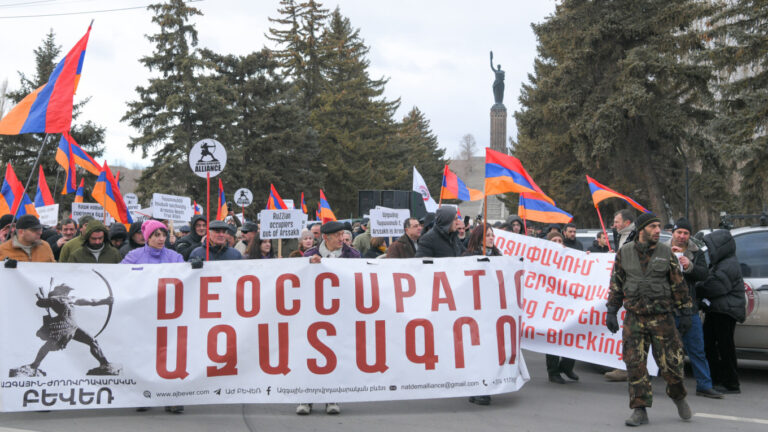
Actors potentially involved in destabilization include local pro-Russian political networks, media outlets, and certain oligarchic channels. A particularly significant role may be played by the instrumentalization of protest sentiment linked to church institutions to deepen societal polarization. The use of criminal networks to organize unrest cannot be ruled out, allowing Moscow to formally deny responsibility. In this context, the base in Gyumri could serve as a tool of psychological pressure and intimidation without the use of direct force.
Analysts outline five possible scenarios. The most likely involves political takeover through election interference and media-driven discrediting of the authorities, forcing the country back into Moscow’s orbit. The second scenario envisions an attempted coup through the creation of “salvation committees” and the financing of mass protests. The third involves creating controlled chaos along the borders, followed by an offer of Russian “peacekeeping” services. The fourth includes punitive economic coercion and cyberattacks. The least likely but most dangerous scenario is limited kinetic action against infrastructure to achieve shock-based coercion.
Beyond Armenia, Moldova and Georgia are also considered high-risk zones. Moldova is viewed as the most vulnerable due to the presence of Transnistria, where a ready-made Donbas-style model already exists. There, Russia is conducting full-scale interference aimed at derailing the country’s EU integration through the organization of unrest and electoral manipulation. In Georgia, the strategy focuses on gradual constitutional capture of the state and the adoption of laws suppressing civil society along Belarusian lines. Across all these regions, Russia’s strategic objective is not territorial assimilation, but the establishment of full political control and the prevention of accession to Western institutions.