

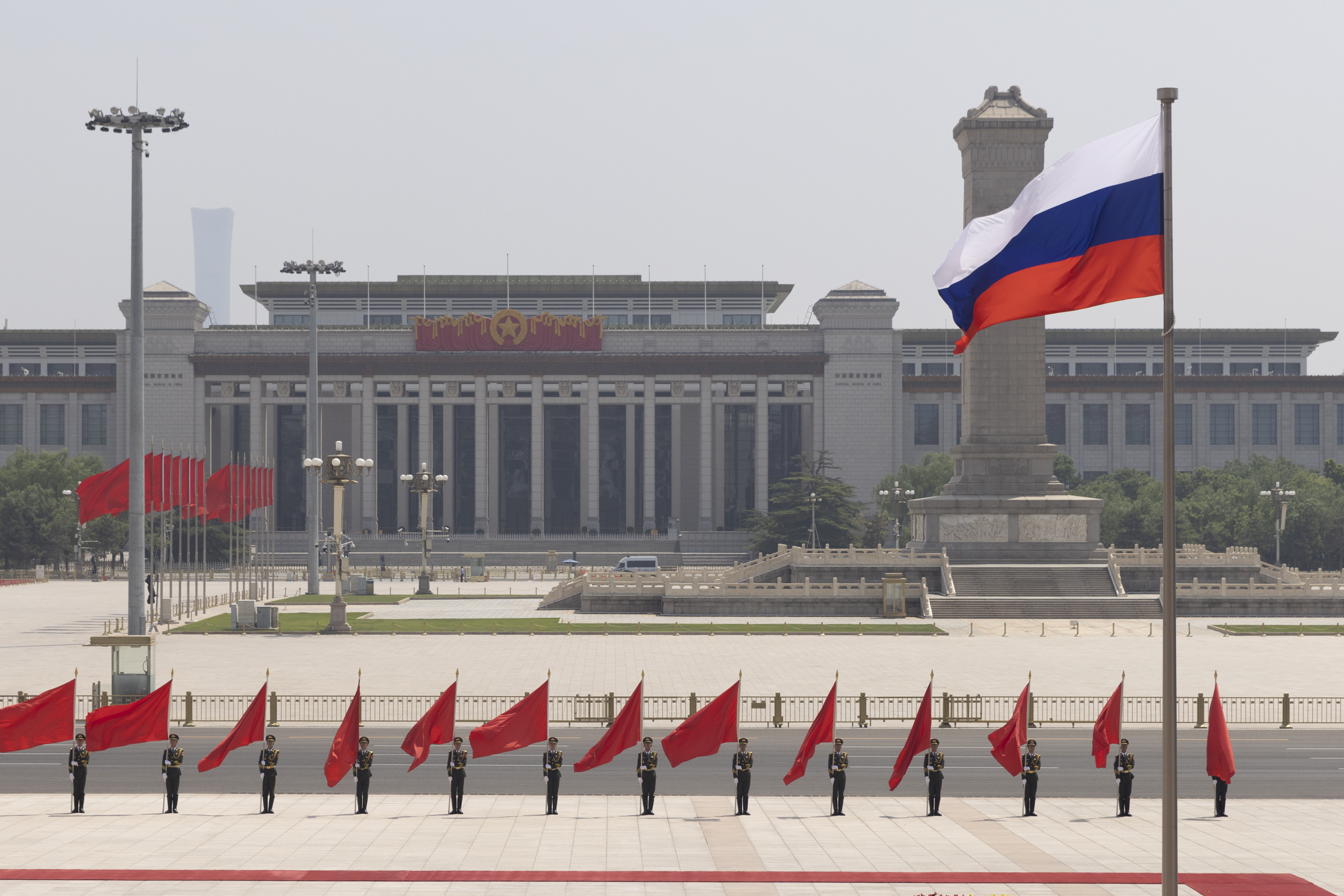

Main image: Thomas Peter/AP
The American think tank Center for European Policy Analysis (CEPA) has published a report proposing a rethink of the logic of countering Russia and China. Instead of treating them as two separate threats, analysts suggest framing them as a single “metathreat” arising from the combination of the two regimes, rather than from each acting individually.
The key conclusion is that relations between Moscow and Beijing are asymmetrical but stable. China helps Russia adapt to sanctions, maintain a militarized economy, and replace lost Western markets. However, it does so on its own terms: Chinese banks avoid excessive sanctions exposure, and all economic cooperation is structured in a way that primarily benefits Beijing. As a result, Russia is becoming increasingly dependent on China for goods, technology, financial channels, and export markets, while China retains strategic flexibility.
In the military sphere, there is no full alliance, but there are regular consultations, joint exercises, and coordinated positions on security issues. Russia needs China’s political and technological support, while China uses Russia as a tool to pressure the United States and to strengthen its position in Eurasia.
The report also highlights the information and technological dimension. Here, the two regimes complement each other: China’s capabilities in artificial intelligence, digital surveillance, and control combine with Russia’s experience in disinformation and cyber influence. For open societies, this means increased pressure across multiple fronts — from social media manipulation to the spread of authoritarian technological standards.
Finally, both countries actively promote an alternative world order through BRICS, the Shanghai Cooperation Organization (SCO), infrastructure projects, and energy cooperation. Its core message is simple: sovereignty and stability are more important than human rights and democracy, with the Global South as its main audience.
CEPA authors warn against two extremes: it is wrong to see this alignment as temporary or insignificant, but also incorrect to view it as a fully unified monolithic bloc. The practical conclusion is that the West should move from separate containment strategies for Moscow and Beijing to a comprehensive approach addressing their combined system of influence.